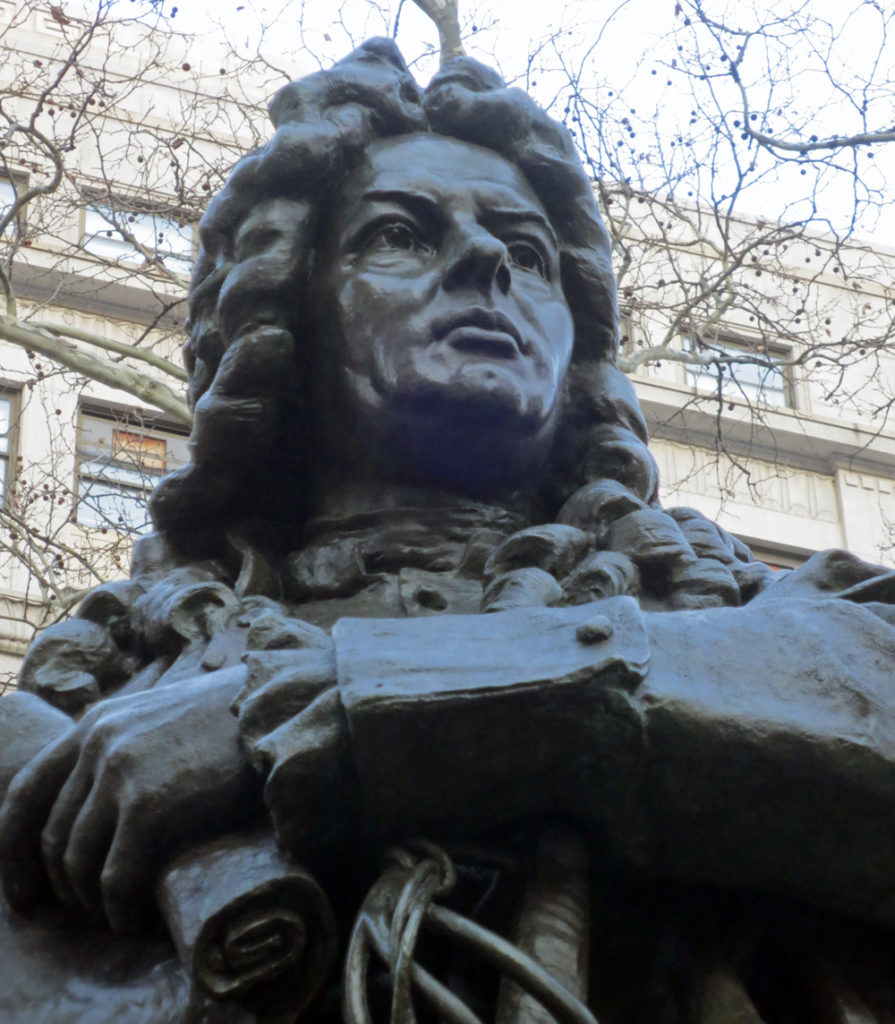
- Date: 1896
- Sculptor: George Edwin Bissell
- Medium & size: Bronze, over life-size, on a granite pedestal.
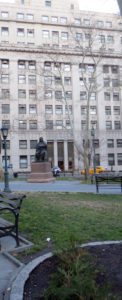
- Location: Thomas Paine Park / Foley Square, lower Manhattan
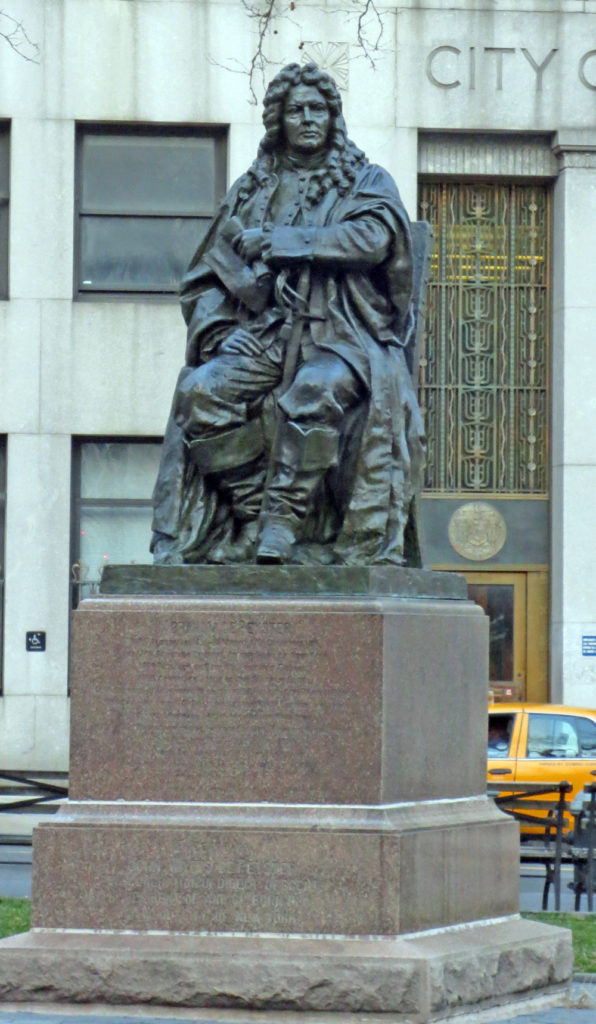
De Peyster was born in New Amsterdam in 1657 to parents who had recently immigrated from Holland. When the British took over the town in 1664, many Dutch continued to live there, including the de Peyster family, who were prominent merchants.
But there was nevertheless a divide among the residents. In 1689, when William and Mary came to the English throne, many of the Dutch-born or -descended townspeople supported militia captain Leisler, who rebelled against Lt. Governor Francis Nicholson. Nicholson was a strong supporter of James II, who had fled England. Abraham de Peyster survived the dispute and was mayor of New York from 1691 to 1694. He became a member of the town council, a justice in the Supreme Court of Judicature, treasurer for the provinces of New York and New Jersey, and a colonel in the militia of the city and county of New York. When he died in 1728, he was one of the city’s wealthiest merchants. (See Encyclopedia of New York City [1995] p. 328.]
De Peyster and Federal Hall
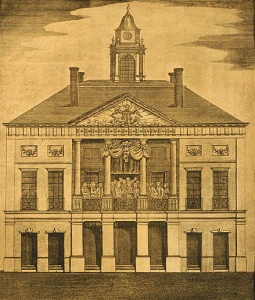
Around 1699, de Peyster donated land on Wall Street for the construction of a new city hall. The city hall, later named Federal Hall, served as the first capitol of the United States and was the site of George Washington’s first inauguration as president.
The peripatetic De Peyster sculpture
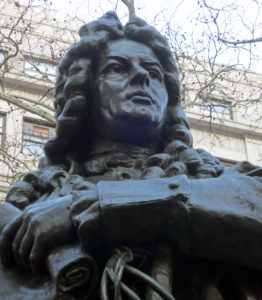
The sculpture of de Peyster was commissioned by his great-great-great-grandson, John Watts de Peyster. De Peyster is shown with knee-high boots, a sword, a roll of papers, and the sort of long, curly wig one associates with lawyers – reminding viewers of his political, judicial and military roles.
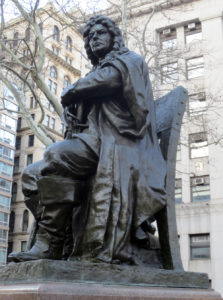
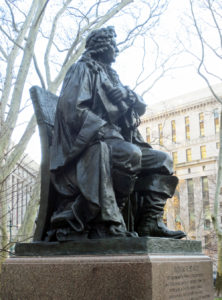
The sculpture was intended for Battery Park, but was placed instead in Bowling Green in 1896. In 1897, however, the original version was given to Franklin & Marshall College in Pennsylvania by John Watts de Peyster, who had recently donated money to the College for the Watts-de Peyster Library (erected 1897, demolished 1937). That version still stands on F&M’s campus. (See this article.) A slightly smaller version of the de Peyster sculpture was cast for New York and placed in Bowling Green.
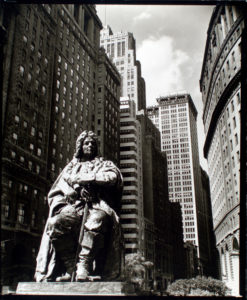
In 1972, when Bowling Green underwent a major renovation, de Peyster was shifted to Hanover Square.
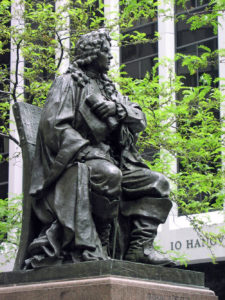
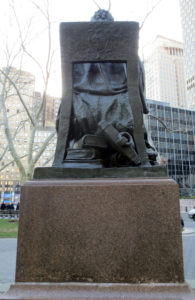
When Hanover Square was renovated in 2004, de Peyster went into storage for years. The sculpture was placed in Thomas Paine Park (near the New York Courthouse) in 2013. (See this article.)
More
- Bissell’s other works outdoors in New York City are Chester Alan Arthur and John Watts in Trinity Church graveyard.
- The subjects for my current series of blog posts are works I haven’t yet written about from among outdoor sculptures in New York City. I’m posting New York’s outdoor sculptures in chronological order on my Instagram feed.
- In Getting More Enjoyment from Sculpture You Love, I demonstrate a method for looking at sculptures in detail, in depth, and on your own. Learn to enjoy your favorite sculptures more, and find new favorites. Available on Amazon in print and Kindle formats.
- Want wonderful art delivered weekly to your inbox? Check out my free Sunday Recommendations list and rewards for recurring support: details here.