This series of 12 posts is a quick overview of the major periods in Western art, focusing almost exclusively on life-size or over-life-size sculpture. The series is also available as a playlist on my YouTube Channel.
Each post will have one important work as an illustration, and will include:
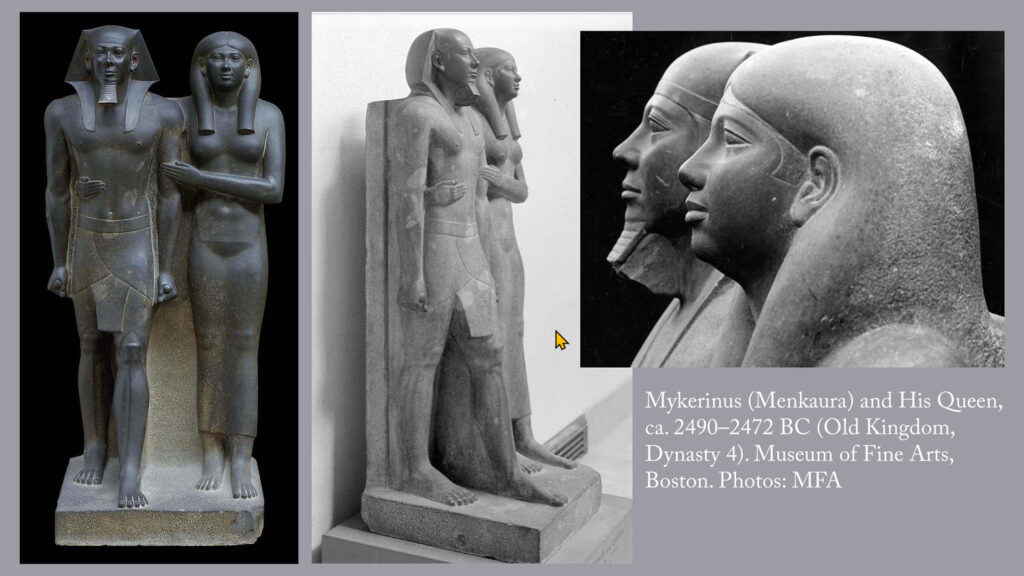
- Date, with a timeline
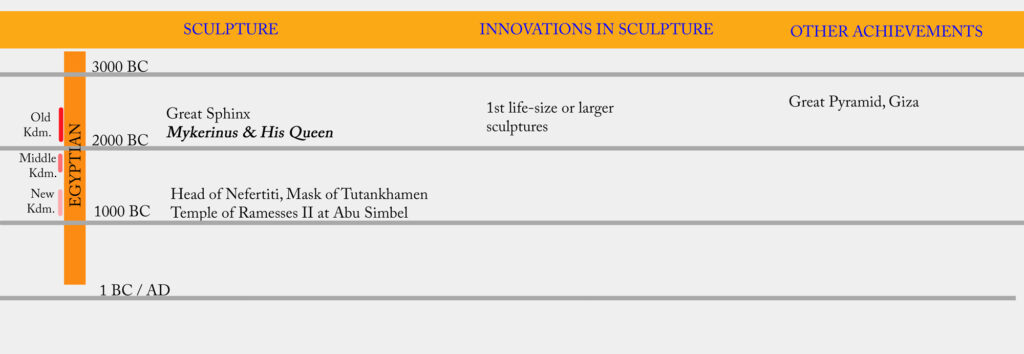
- Location, with a map
- Most common media
- Most common subjects
- Dominant ideas in art, with a note on contemporary philosophy
- Style
- Major innovations
- Famous artists
- A few other important works
- Where to see original works of this period
- Further reading
Why this synopsis?
Back in 2003, when I’d been on a couple cruises to Europe, I was surprised to realize that many of the people who went on excursions had no framework for appreciating the splendid artworks they were paying to see. In fact, they had no reason for visiting any artworks other than “It’s Tuesday, it’s Paris, we must take the Louvre tour.”
So I put together a six-hour course with slides on highlights of Western sculpture and painting, which I called “the Crash Cruise Course”. These “Scupture Synopsis” posts are based on the “cheat-sheets” I made as a supplement to the Crash Cruise Course. If you want to become familiar with major art-historical periods, this series of posts is a good place to start.
Eventually I changed my focus from surveying major artworks to searching out major innovations. That resulted in Innovators in Sculpture and Innovators in Painting – a good place to start if you want a sweeping overview of progress in art.
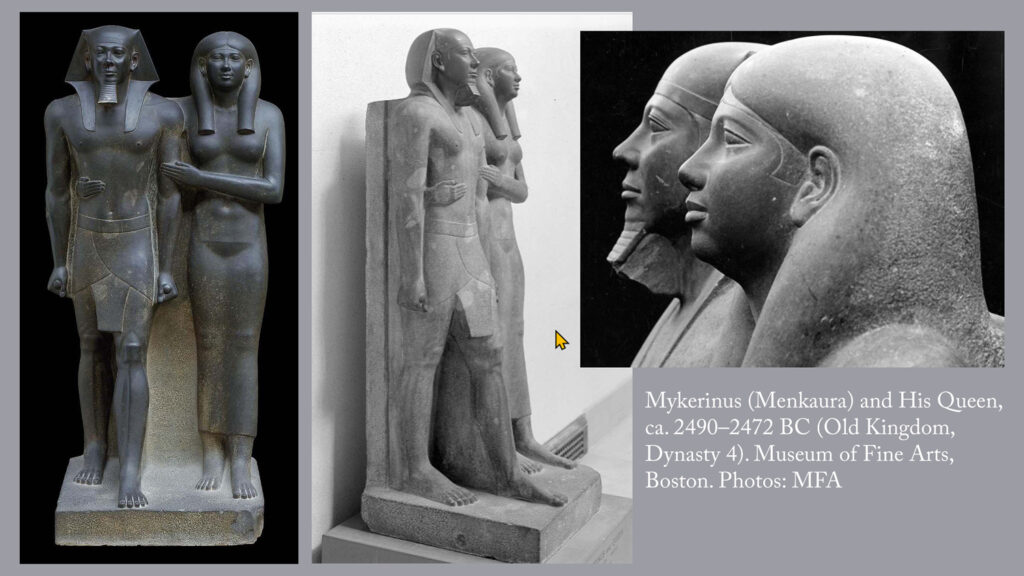
Characteristic example of Egyptian sculpture
Mykerinus (Menkaura) and His Queen, ca. 2490–2472 BC (Old Kingdom, Dynasty 4). Museum of Fine Arts, Boston.
Dates of Egyptian sculpture
Begins approximately 3100 BC; as a recognizable style, Ancient Egyptian art continues (under the rule of assorted foreigners) until at least the 1st century BC.
Note: We know, generally, the order in which Egyptian pharaohs ruled. But because Ancient Egypt was isolated during most of its history, it’s difficult to figure out how the pharaohs’ reigns correspond to events outside Egypt. Dates for the major periods vary by as much as a century from source to source. I’m using dates from Encyclopedia Britannica.
Dynasties are included because some historians date by dynasty rather than year.
- Early Dynastic Period (Dynasties I-II)
- Old Kingdom, ca. 2575-2130 BC (Dynasties III-VI)
- First Intermediate Period (Dynasties VII-X)
- Middle Kingdom, ca. 1938-1630 BC (Dynasties XI-XIII)
- Second Intermediate Period (Dynasties XIV-XVII)
- New Kingdom, ca. 1539-1075 BC (Dynasties XVIII-XX)
- Third Intermediate Period (Dynasties XXI-XXV)
- Late Period, ca. 664-332 BC (Dynasties XXVI-XXXI)
Location
The core of Ancient Egypt was a ten-mile-wide strip of agricultural land along 600 miles of the Nile River, running from the Mediterranean south to Luxor.
Media
Granite and limestone in shades of white, gray, black, and beige, sometimes flecked.
Subjects
- Portraits of pharaohs and high officials, and gods with animal heads, for tombs and temples. Common people only appear in small-scale sculptures.
- Sculptures are placed inside temples (where only priests and high officials can see them) or in tombs (where no one sees them after the tomb is sealed). The continuity in Egyptian style comes not because sculptors see the work of their predecessors and contemporaries, but because a rigid set of conventions is followed. See Style below.
Dominant ideas
- Only the gods and the highest level of society (pharaoh, priests, officials) matter.
- The afterlife is more important than this life.
- Change is undesirable.
- Note: For the Egyptians, religion is the explanation for everything.
Style
Egyptian art uses a rigid set of conventions:
- Hair is stiff, like a wig.
- All faces have similar shapes and features.
- Proportions of bodies are set by a grid drawn on the block before carving begins.
- Arms are stiffly at sides and attached to torso.
- For men, left foot is forward, weight on back foot, and both feet are flat on ground. Women’s feet are side by side.
- Large-scale stone sculpture is never free-standing: stone is left between the legs, and the spine is attached to a support.
- Figures are carved in separately from the four slides of a block, and retain a cubic look.
- Men wear a kilt, women a tight-fitting dress.
Innovations in this period
Life-size sculptures of human beings first appear. Previously sculptures had been hand-size, or not much larger.
Big names in art
None known. Sculptors were servants or slaves of the pharaoh – craftsmen whose names were not considered worth recording.
Other important examples
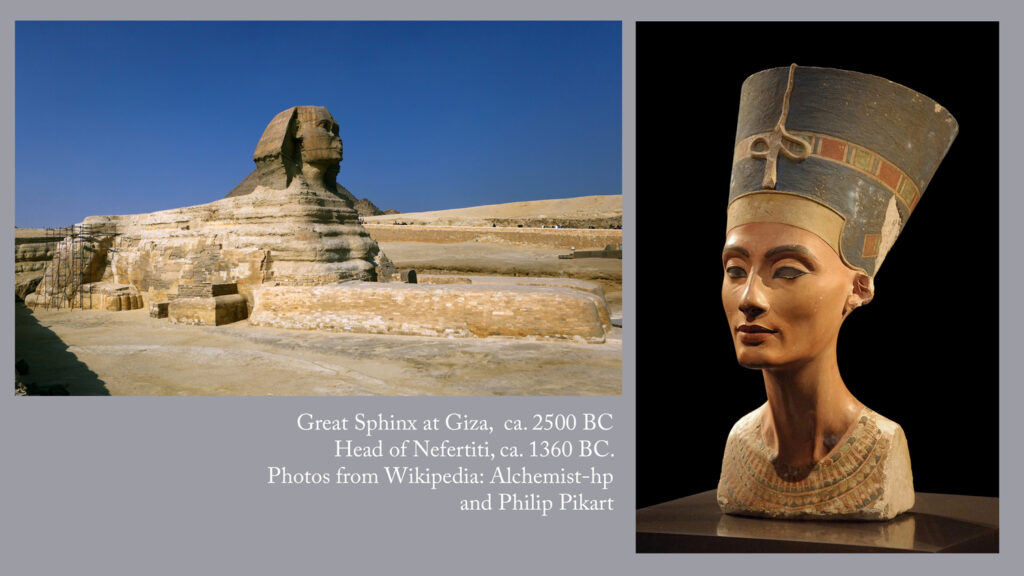
- Great Sphinx at Giza, ca. 2500 BC
- Head of Queen Nefertiti, ca. 1360 BC
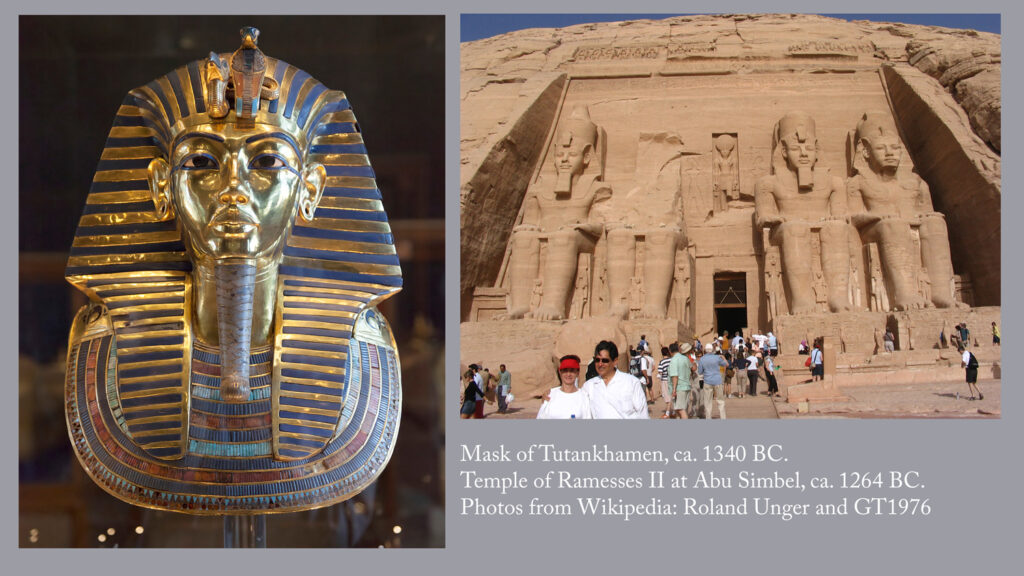
- Mask of Tutankhamen, ca. 1340 BC.
- Temple of Ramesses II at Abu Simbel, ca. 1264 BC
Where to see the originals
Links are to the departments of Egyptian art in these museums.
- Egyptian Museum in Cairo
- British Museum
- Louvre
- Metropolitan Museum of Art
- Museum of Fine Arts, Boston
- Vatican Museums
Further reading
- Innovators in Sculpture, Chapter 1.
- List of books on Ancient Egypt by an Egyptologist
- For fun: Amelia Peabody murder mysteries, whose main characters are archeologists excavating in Egypt during the late 19th and early 20th centuries. Twenty books in all, starting with Crocodile on the Sandbank.