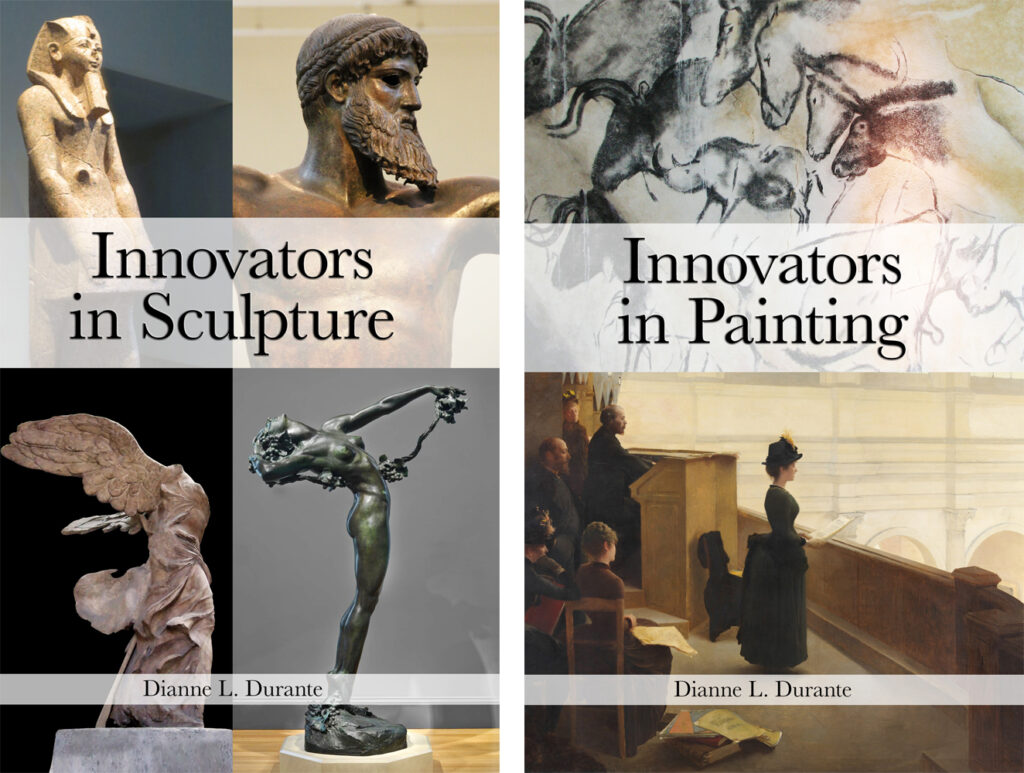
The video of this post includes samples pages from both books.
- Innovators in Sculpture: 6×9 inches, 162 pp. including 385 color illustrations. Available from Amazon; other stores via Ingram (9781088090497 print, 9781088114858 ebook)
- Innovators in Painting: 6 x 9”, 140 pp. including 199 color illustrations. Available from Amazon, and in other stores via Ingram (9781088114681 print, 9781088114773 ebook)
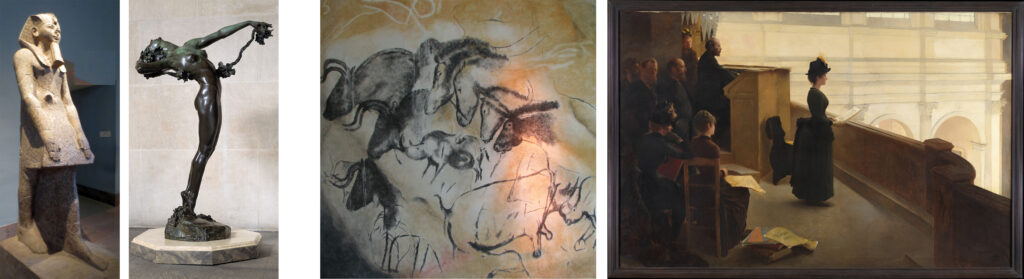
How did artists progress from Egyptian sculptures to a work such as Frishmuth’s The Vine , or from cave paintings to LeRolle’s The Organ Rehearsal? To find out, we focus on innovations that gave the artist who created them – and all those who followed – greater power to make viewers stop, look, and think about their works.
Who’s this jargon-free book written for?
- Anyone who is interested in art or art history, but is daunted by thousand-page art-history textbooks or two-semester courses that cover the art of every major civilization worldwide. These two volumes (162 pp. and 140-pp.) are art history in essentials.
- Anyone planning to visit a major museum of Western art and wants a quick refresher.
- Sculptors, painters, and graphic artists who want a big-picture view of the development of the expressive means that are available to them.
- Anyone who loves competence: this book is full of thinkers who find new ways to show others their distinctive point of view.
I highly recommend print format for these two books: it’s easier to keep relevant images in front of you. Since I read almost everything on Kindle these days, I am offering a Kindle version – but due to Amazon’s restrictions, the images in the Kindle version are not high-resolution.
Brevity and clarity
My main concerns in writing the Innovators books were keeping them short and clear.
- For the sake of a manageable length, the scope is limited to representational art in Western Europe and the United States.
- The focus is on major innovations, rather than every development or style. In sculpture there are only eleven. In painting there are 29, which I’ve divided into 5 categories.
- Abundant illustrations (more than 300 in all) show complete artworks and fascinating details.
- Summaries of innovations appear in the middle of the book (after the Greeks and Romans) and at the end.
- Terms such as “center light” and “foreshortening” are clearly defined.
- At the end, a timeline lists innovations in sculpture and painting alongside major events in politics, science, literature, and philosophy.
- The appendixes offer suggestions for further reading and for visiting museums, so you can easily explore more of the art that interests you.
Testimonials about the Innovators series
- “Dianne writes about her subjects in a clear and easy-to-understand style and structure that refreshingly departs from typical art writers who otherwise make learning about and appreciating art unnecessarily intimidating, incomprehensible or flat boring. Through her various techniques, especially when comparing and contrasting works of visual art based on her aesthetic theories.”
- “Your sculpture essays have expanded my range of enjoyment and helped me think more carefully about my reactions.”
- “I like the format: you ask the reader questions. I read it and I’m like, ‘Hey wait a minute, somebody’s talking to me!’ You totally nailed being ‘down to earth’ and yet extremely perceptive.”
- “Concise, clear, and illuminating”
- “Friendly and accessible”
A note on Ayn Rand’s esthetics
This book isn’t written primarily for Objectivists, but if you’re familiar with Ayn Rand’s works, you’ll recognize the discussion of what art is (in the Introduction) as a paraphrase of Ayn Rand’s definition: “Art is a selective re-creation of reality according to an artist’s metaphysical value-judgments.” The sections on how an artist works and on the purpose of art are also based on my understanding of Rand’s work. The main writings on esthetics by Objectivists are listed in Appendix 3 (Further Reading).
About my writings on art history
I’m a passionate amateur, not an academic. I write on art because I love looking at art and thinking about art, and helping other people do the same. Innovators in Sculpture and Innovators in Painting are based on forty-odd years of looking at art and reading about art and art history. (For more on the evolution of the Innovators books, see Appendix 1 in each.) As a result of my fascination with art, I’ve also written books such as Outdoor Monuments of Manhattan: A Historical Guide; Getting More Enjoyment from Sculpture You Love; and Seismic Shifts in Subject and Style: Nineteenth-Century French Painting and Philosophy. These and my other writings on sculpture and painting are included in Appendix 3.
I’ve made two original contributions to art history. My technique for looking at art closely is described in detail, with examples, in Getting More Enjoyment from Sculpture You Love and How to Analyze and Appreciate Paintings. (As of 2025 I’m working on a revised and expanded version, under the title Getting More Enjoyment from Paintings You Love).
My other contribution is using innovations as a framework for an overview of the history of Western art. That’s set out in the two Innovators books, which have been in the works for 20 years or so. The Innovators books can be read separately, but they complement each other. I’d suggest reading Innovators in Sculpture first. It includes several discussions that aren’t repeated in Innovators in Painting, for example on recognizing innovators, on transmitting innovations, and your emotional reaction to a particular innovative work.
More
- Joseph Kellard reviewed both Innovators books in The Objective Standard, Fall 2021.
- In Getting More Enjoyment from Sculpture You Love, I demonstrate a method for looking at sculptures in detail, in depth, and on your own. Learn to enjoy your favorite sculptures more, and find new favorites. Available on Amazon in print and Kindle formats.
- Want wonderful art delivered weekly to your inbox? Check out my free Sunday Recommendations list and rewards for recurring support: details here.