Research for a visit to Vienna in March 2026, with notes after the visit. Sections: 1) History, 2) Culinary traditions, 3) Restaurants.
1. History of Vienna
1.1 Roman period through 18th century
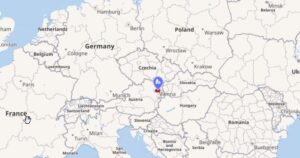
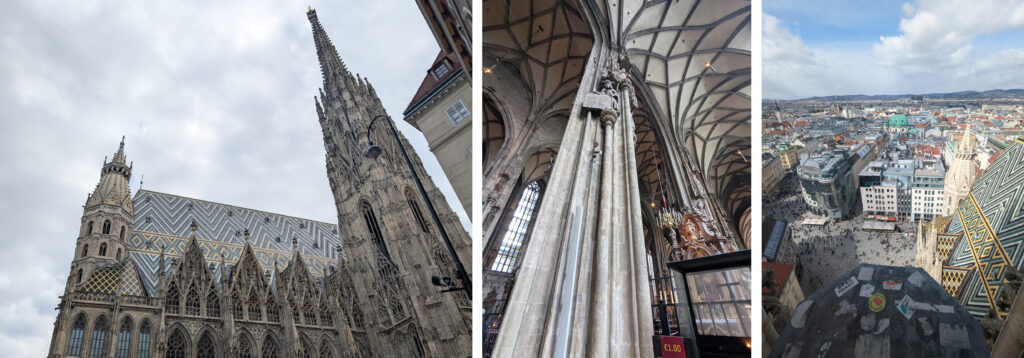
For the Romans, the Danube River was the border of barbarian territory. Vienna (Latin Vindobona) was constructed sometime between 15 BC and 97 AD as a military outpost to defend the border. When the Roman Empire in the West disintegrated, the town faded into obscurity until the 12th century, when it became a favored stop for Crusaders on their way to the Holy Land. The gothic St. Stephen’s Cathedral was begun in 1137, completed in 1578.
Notes on visiting St. Stephen’s: the interior is very impressive; the tour guide was helpful and knowledgeable. The catacombs (creeeeepy) go back centuries, giving you the chance to see many, many, many piles of desiccated bones. The North Tower of St. Stephen’s has a view that’s accessible via elevator. The South Tower (taller) has 343 stairs that wind in a tight spiral around a 6-8″ column. As opposed to the Frauenkirche dome in Dresden or the Old Tower in Prague, the South Tower of St. Stephen’s is not recommended for the faint of heart or those with slippery shoes. There are no handrails, and you’re constantly squeezing past people as you go up and down. On the way up, when you’re next to the column, it feels like there’s barely enough room for a foothold. But still … lovely view!
In 1278 the Habsburgs took control of Vienna (German Wien), making it the capital of their empire for more than 600 years. The University of Vienna (est. 1365) became a major European university.
Vienna was twice besieged (1529 and 1683) by the Ottoman Turks, who were repelled only with difficulty. Vienna then became the furthest point of Muslim expansion into Europe. Following the 1683 victory, the Habsburgs launched a massive Baroque building program, constructing churches such as Karlskirche (Church of St. Charles Borromeo) and palaces such as Schönbrunn and Belvedere.
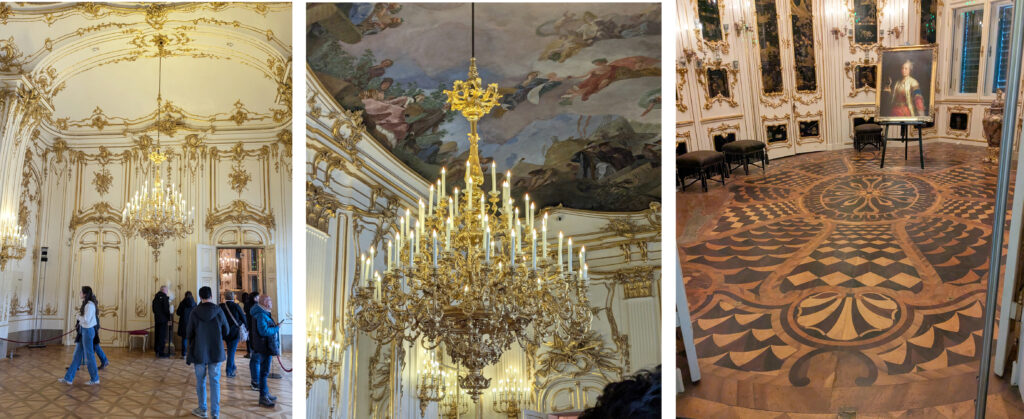
A note on Schönbrunn: To get our bearings on our first day in Vienna, we booked a Viator bus tour of the city plus a skip-the-line tour of Schönbrunn Palace. The bus tour was so-so: we moved to fast to see much. Schönbrunn was extraordinarily crowded when we assembled at 11:00 for our guided tour. Since our guide wasn’t using one of those mic-and-earphone set-ups, we had to stay close to her, and that was very difficult. Perhaps the crowds decrease in the afternoon, if fewer tour groups are passing through? The palace often has concerts in the evening, so going late and then staying for the concert might be a less frenetic way to see Schönbrunn. Its gardens are said to be fabulous, but in late March the gardeners were just beginning to set plants out.
1.2 19th-20th centuries
Napoleon occupied Vienna twice, in 1805 and 1809. After his defeat at the Battle of Waterloo (1815), European leaders converged on Vienna, where they redrew the map of Europe.
Under Emperor Franz Joseph (ruled 1848-1916), Vienna was one of Europe’s largest and most modern cities. During his reign the 1867 Compromise united the thrones of Austria and Hungary, making the Austro-Hungarian Empire the second-largest country in Europe (after Russia), and the 3rd most populous (after Russia and the German Empire).
In 1897 the Vienna Secession began, with the motto “To every age its art. To art its freedom.” The movement was led by Gustav Klimt, whose painting The Kiss is available on every knickknack you can think of, and about a hundred more that haven’t occurred to you. Vienna Secession art is related to Art Nouveau and Jugendstil. Its rejection of the past was essential for modernist movements such as abstract art.
#/media/File:The_Kiss_-_Gustav_Klimt_-_Google_Cultural_Institute.jpg)
Austria-Hungary remained one of Europe’s great powers until after World War 1. At that point (1919), nationalist movements split it into Austria, Hungary, Czechoslovakia, Yugoslavia, and Poland. Vienna became the capital of a small, landlocked country.
The Nazis occupied Austria in 1938, in the Anschluss (“annexation”): quite a genteel word for rolling into the country with tanks. (Fans of The Sound of Music might remember the Anschluss as the reason the Von Trapp family fled Austria.) In February and March 1945, the Allies bombed Vienna, targeting infrastructure but with collateral damage to St. Stephen’s Cathedral, the Albertina, and other landmarks. The city was liberated by a Russian ground offensive in April 1945. In the 1930s, Vienna had a thriving Jewish population of 200,000 or so. By the end of World War 2, more than 90% of them were killed or had fled.
Vienna rebuilt and is now a tourist destination for its music, architecture, coffeehouses, and parks.
Other sights to see
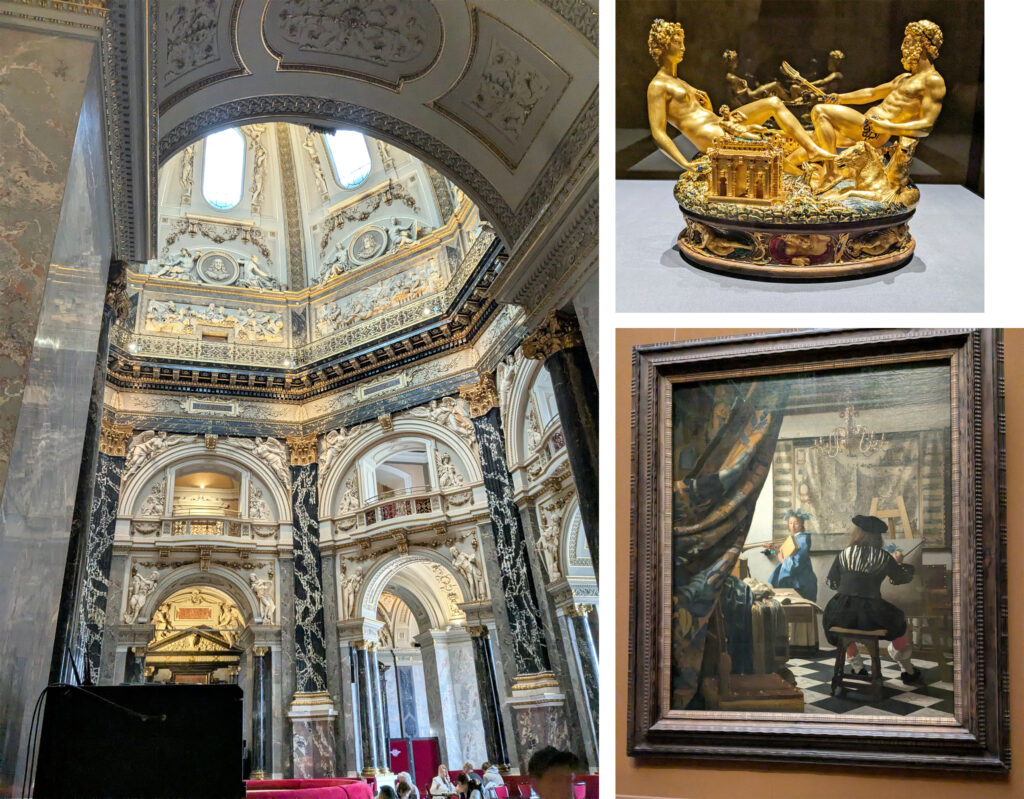
- Kunsthistorisches Museum includes many expensive, precious objects of the sort on display in Dresden’s Green Vault. The most spectacular is Cellini’s glittering salt-cellar (below). The KHM has the world’s largest collection of paintings by Pieter Bruegel the Elder: I find them fascinating for their details. The stunning building makes the Metropolitan Museum look drab. We arrived at the KHM 9:20 or so and were at the head of the line to enter at 10 – a good thing, because the very long line behind us had no shelter from the rain. When we left, the line was even longer.
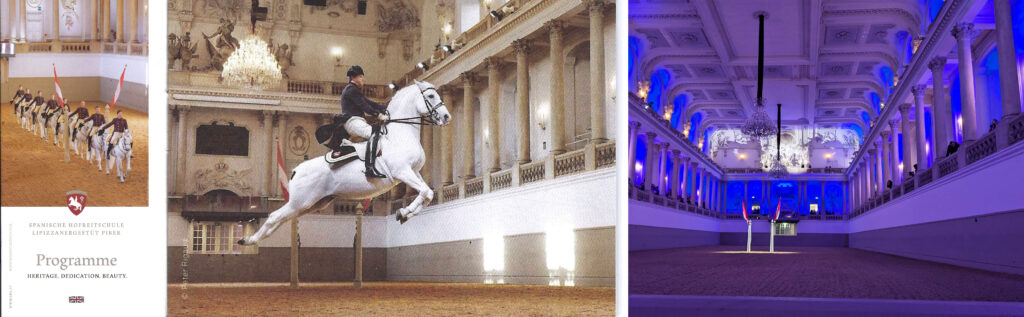
- Spanish Riding School at Hofburg Palace, a.k.a. the Winter Riding School, was founded by the Habsburgs in the late 1500s. I knew of it from reading Mary Stewart’s Airs Above the Ground years ago. The Lipizzaner horses are trained to do amazing moves, singly or in groups. Their riders wear frockcoats and buckskin breeches. The main show, daily at 11 a.m., sells out very fast: my husband and I only got in by taking single tickets in 2 separate areas. No photos are allowed during the performance, which is to music by Strauss, Mozart, Bach, etc. The best seats are on the short side that has the lowest barrier in front.
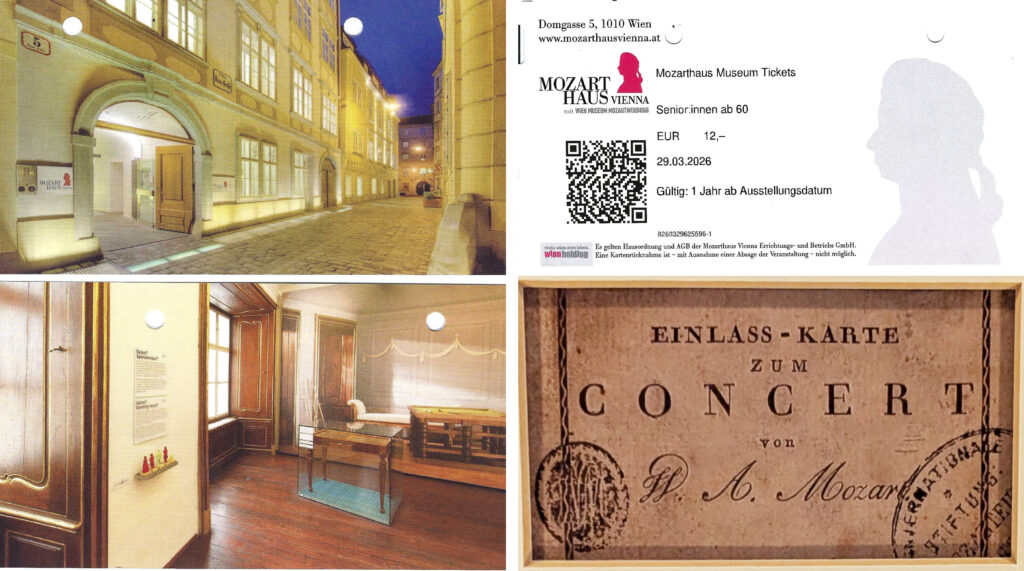
- Mozarthaus (Domgasse 5). There are other Mozart museums, but this is the only house still standing that Mozart lived in. You begin on the top floor, with an exhibition about Vienna in Mozart’s time. The next floor down is on music in Mozart’s time (Salieri, Haydn, etc.), and the level just above the ground floor is the apartment that Mozart and his family lived in. The exhibits include lots of reproductions of contemporary images and manuscripts, a bronze death mask of Mozart, an 18th-c. frock coat, etc. With the audio guide, seeing the museum took about 2.5 very enjoyable hours. No photos allowed.
- Not recommended: the Mostly Mozart store on the Kärntner Straße, which has cheap junk, most of it not Mozart. Mozart Mythos on Kaertner Strasse looks like a noisy multimedia place, although I didn’t go inside to find out.
- Albertina: we stayed nearby, but the exhibition poster was for something very modern, which made me drop this museum off my must-see list.
- We wanted to look at Art Nouveau architecture by Otto Wagner, but the museum was closed until April (?).
- Our hotel was just off Kärntner Straße. Most sights were in easy walking distance or easy to reach by subway – so this is a great location if you don’t want to deal with driving a car.
Music in Vienna
The presence of the Habsburg court made Vienna a magnet for musicians. In the 18th-19th centuries, Gluck, Haydn, Salieri, Mozart, Beethoven, Schubert, the Strausses (father & son), Bruckner, Brahms, and Mahler all lived in Vienna. Beethoven’s Fidelio, Mozart’s Magic Flute and Marriage of Figaro, and Strauss’s Die Fledermaus all premiered there.
The Viennese celebrate music: it’s easy to find excellent performances of classical works. Here are the 3 we attended.
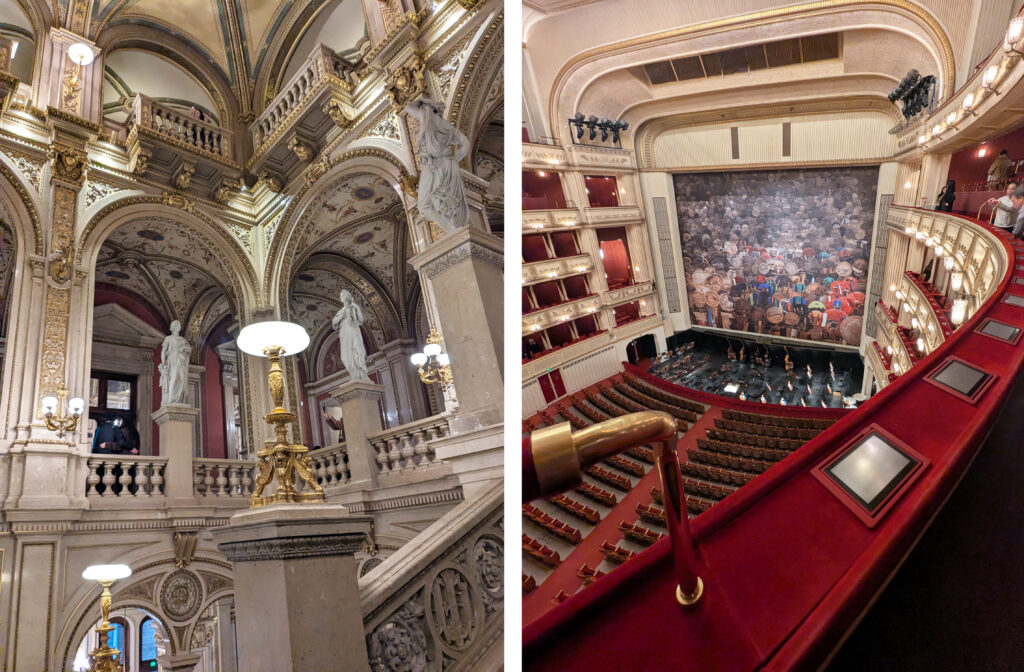
- Vienna State Opera, Staatsoper. a gorgeous building and very well organized: your coat check is close to your section of the theater, as is your refreshment area. You can pre-order wine and Gerstner’s snacks, and they’ll be waiting for you at intermission. We saw Smetana’s Bartered Bride in a very … non-traditional production. More on that here (section 4).
- Haus der Musik concert. Most of the Haus der Musik is a multimedia exhibit aimed at kids, but the top floor has small concert space with good acoustics. We heard a string quartet play Mozart, Dvorak, Beethoven, Haydn, Schubert, and Strauss.
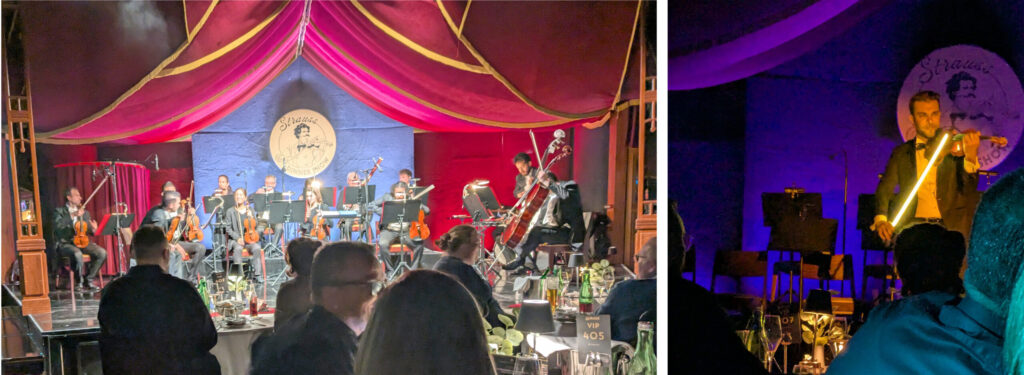
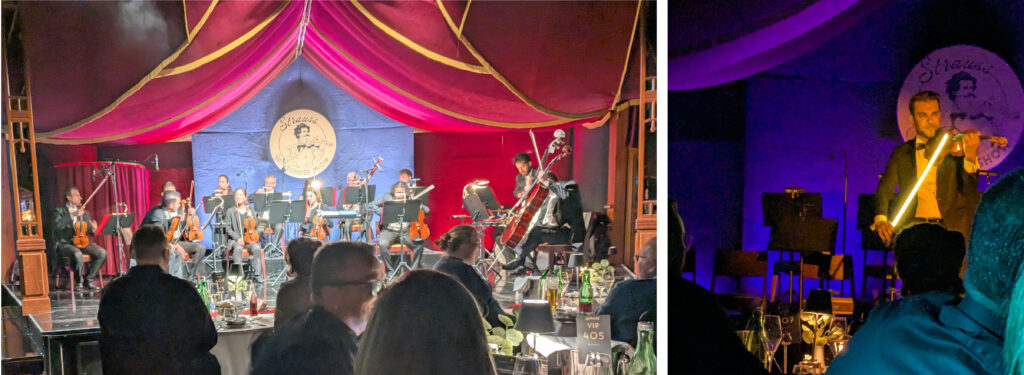
- Strauss Dinner Show (www.StraussDinnerShow.com). This was sold out, but we got tickets from Viator – I’m guessing Viator buys a block of tickets every night. The dinner and concert are in a venue in Vienna’s huge amusement park, the Prato, famous for its huge ferris wheel. The outside is an inflatable, like a bouncy house. Inside: parquet floors and a red velvet tent. At sign-in you get a card with table number; coat-check and drinks are charged to the table card, which you settle at the end of the evening at the same window where you order pre-show drinks. (Waiters don’t deal with money.) Performers: a 14-pc orchestra, a soprano, and 2 dancers from Vienna Royal Ballet. Music: mostly but not entirely Strauss, each piece introduced by the conductor in English. During the dessert course, the first violinist played several energetic solos of pop music with recorded background. Loved the LED color-changing bow! The average age in the audience was 50 or less.
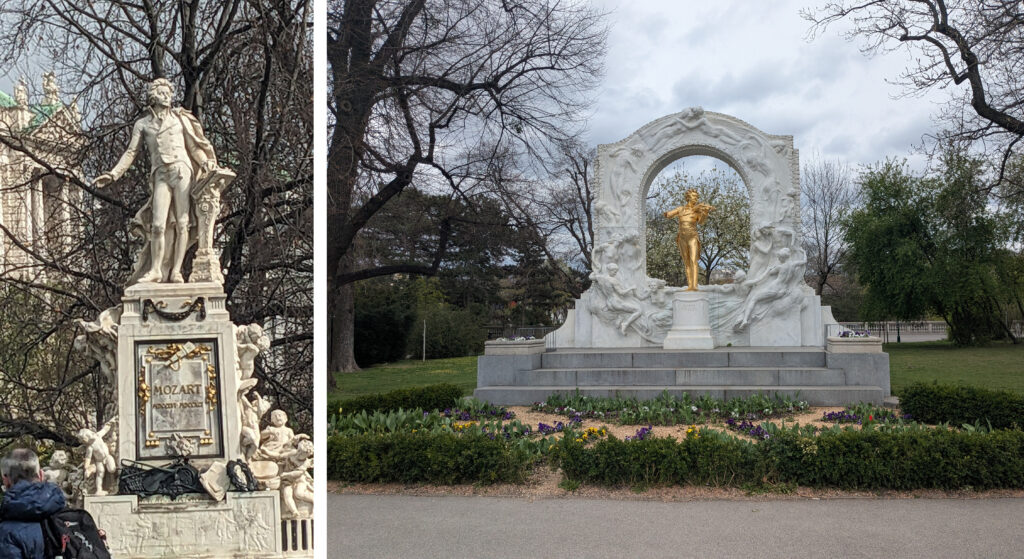
- Vienna has memorials to its musicians. Here are Mozart and Straus, both lifesize, both very well maintained.
Judging from what we saw advertised, you could attend a concert of classical music every night of the week in Vienna. The churches offer regular programs, sometimes advertised as being on period instruments.
2. Culinary traditions
Hearty comfort food, like elsewhere in Central Europe, but with some distinct flavors. The Viennese are particularly fond of veal.
2.1 Typical & unusual ingredients
Apricots: Marillen
Small, flavorful apricots, often from Wachau. Used in jams, dumplings and fillings such as Sachertorte. I tried a dumpling with these in it: too bitter for my taste, although the sweetness of the dumpling offset it.
Farmer’s cheese: Topfen or Quark
Mild, creamy, slightly tangy fresh curd cheese. Also used in Dresden and Prague. The usual substitute is 9 parts ricotta and 1 part sour cream.
Ham: Speck
Austrian-style cured or smoked ham or bacon. Tiroler Speck is air-cured in the mountains, and is leaner and more aromatic than typical bacon or prosciutto. Sliced thin for snacks, in dumplings, or in sandwiches.
Mushrooms: Schwammerl
Foraged wild mushrooms, especially chanterelles. Used in soups, sauces, and dumplings, often with parley or cream.
Plum jam: Powidl or Powid
Plums cooked for hours, without added sugar: tangy and sweet. Used for filling sweet rolls, strudels, or dumplings.
Pumpkin seed oil: Kürbiskernöl
“Green gold” is made from Styrian pumpkin seeds. It is drizzled on salads, soups, cheeses, meats, even ice cream.
Veal offal: Beuschel
Finely chopped veal lungs, heart, and spleen. Used for Beuschel ragout (2.2.1).
2.2 Classic dishes
2.2.1 Entrees
Boiled beef: Tafelspitz
Cuts like rump or sirloin, simmered in spiced broth with root veggies, herbs, and marrow bones. The clear broth is served as a first course. The meat is the second course, with sides like potato pancakes, creamed spinach, or apple-horseradish sauce.
Cabbage pasta: Krautfleckerln
Caramelized cabbage (often with onions, butter, caraway seeds, salt, pepper, and a bit of sugar) mixed with pasta, sometimes with bacon or garlic.
Fried chicken: Backhendl
Breaded and deep-fried half chicken.
Goulash: Wiener Saftgulasch
Slow-cooked beef stew with onions, paprika, and spices, often topped with sausage or served with bread dumplings (Semmelknödel). Thicker than Hungarian goulash. Variation: Fiakergulasch, with sausage, fried egg, and pickles.
Mac ‘n’ cheese: Käsespätzle
Cheesy egg noodles.
Offal ragout: Beuschel
Upscale stew made from finely chopped veal lungs, heart, and spleen (= veal offal, 2.1), in a creamy, tangy sauce with capers, lemon, and herbs. Served with dumplings or bread. Bold and flavorful.
Pan-fried beef steak: Zwiebelrostbraten
Beef (often sirloin) topped with crispy fried onions and gravy, served with potatoes or dumplings.
Roast pork: Schweinsbraten
Slow-roasted pork (often shoulder or belly) seasoned with caraway, garlic, and herbs. Served with sauerkraut, dumplings, or gravy.
Smoked meat with sauerkraut: Selchfleisch
Smoked meat (usually pork, sometimes beef) with sauerkraut and dumplings.
Veal cutlet: Wiener Schnitzel
Veal cutlet pounded flat, coated in flour, egg, and breadcrumbs, then pan-fried in butter or oil until crispy. Traditionally served with lemon wedge, parsley potatoes, or potato salad, and sometimes with cranberry sauce. Pork versions are cheaper. Not a light meal, but very tasty.
2.2.2 Soups
Vienna is known for rich broths, usually based on beef, with creative garnishes or dumplings.
Beef broth: Rindsuppe
The classic “national soup” of Austria, and the foundation for many other soups. Clear golden beef broth simmered for hours with bones, marrow, root veggies (carrots, celergy, leek, parsley), onions, and spices.
Beef broth with bacon: Speckknödelsuppe
Beef broth with bacon-speck dumplings.
Beef broth with cheese dumplings: Kaspressknödelsuppe
Broth with dumplings of pressed cheese and bread. Common in Alpine-influenced spots.
Chicken soup: Alt-Wiener Suppenhuhn or Alt-Wiener Suppentopf
Clear chicken (or chicken and beef) broth with meat, veggies, and often noodles.
Liver dumpling soup: Leberknödelsuppe
Beef broth with dumplings of calf’s liver, bread, eggs, onions, and herbs. My husband liked this.
Pancake strip soup: Frittatensuppe
Beef broth with crispy strips of thin, savory pancakes (like crepes) floating on top. I had this at Gerstner’s: very tasty, although the strips of pancakes make it tricky to eat.
Potato soup: Wiener Erdäpfelsuppe
Creamy potato soup with root veggies (carrots, celeriac), bacon or speck, onions, and sometimes dried porcini mushrooms.
Semolina dumpling soup: Grießnockerlsuppe
Fluffy semolina dumplings in clear beef broth.
2.2.3 Snacks
Apricot-filled donuts: Marillen Krapfen
Fluffy donuts filled with apricot jam (2.2.1), dusted with sugar. These apricots are more tart that I was used to.
Hazlenut-cream filled wafers: Manner Schnitten
What it says.
Meatloaf: Leberkäse Semmel
Slices of meatloaf (like a fine spam) on a soft roll, sometimes with mustard or horseradish.
Pork sausage stuffed with cheese: Käsekrainer
Often served on an roll with mustard.
Potato dough: Langos
Large fried disc of potato dough, topped with garlic, cheese, or sour cream.
Pretzels: Brezn
Soft, salted pretzels, often served with cheese dip or mustard.
Sausages on a roll: Wiener Würstel
Thin boiled sausages (beef or pork) on a long bun, with mustard or ketchup.
2.2.4 Desserts
Favorites: flaky pastries, rich chocolate, fruit fillings, powdered sugar.
Almond pastry: Linzer Torte
Nutty almond pastry with raspberry jam lattice.
Apple strudel: Apfelstrudel
Famous Viennese dessert: flaky pastry filled with spiced apples, raisins, cinnamon, breadcrumbs, sometimes nuts, dusted with powdered sugar. Often served warm with vanilla sauce or whipped cream. I had apple strudel at Gerstner’s: delicious! I also had the cherry variation, ditto.
Cake layered with chocolate buttercream: Dobostorte
Sponge cake layered with chocolate buttercream, topped with caramel.
Cake soaked in rum: Punschkrapfen
Small rum-soaked sponge cake covered with pink fondant: a boozy petit-four.
Cheese strudel: Topfenstrudel
Strudel filled with cheese (2.1).
Chocolate cake with apricot jam: Sachertorte
A famous Viennese dessert: dense, moist chocolate sponge cake layered with apricot jam (2.1), glazed with dark chocolate, served with unsweetened whipped cream (Schlagobers). Invented in 1832 by Franz Sacher of the Hotel Sacher. I heard the lines at the Hotel Sacher were long and the prices high, so I didn’t try it there. Other pastries shops also offer it.
Chocolate pralines: Mozartkugel
Dark chocolate shell filled with pistachio-marzipan and nougat layers. The original is from Fürst in Salzburg (handmade, silver-blue foil), but many Viennese chocolatiers sell versions. Tasty.
Crepes with fillings: Palatschinken
Thin crepes rolled or folded around apricot jam (2.1), Nutella, Topfen (2.1), or fruit. Often dusted with powdered sugar or served with vanilla ice cream.
Custard slice or vanilla slice: Cremeschnitte
Puff pastry on top and bottom holding a thick layer of vanilla custard, dusted with powdered sugar, served in squares. Similar to French mille-feuille or Italian millefoglie.
Emperor’s Mess: Kaiserschmarrn
Fluffy torn-up crepes, caramelized in butter, studded with raisins, dusted with powdered sugar and served with plum compote (2.1), applesauce, or berry jam. Supposedly created for Emperor Franz Joseph (1.2). I had this in a Biergarten in Dresden: very tasty.
2.2.5 Beverages
Coffee
The Viennese are very big on coffee.
- Wiener Melange: mild espresso with hot milk, topped with milk foam. Smoother and milkier than cappuccino.
- Einspänner: strong black coffee (espresso) topped with unsweetened whipped cream, dusted with cocoa or cinnamon.
- Kleiner / Großer Brauner: small / large espresso with a dash of milk or cream.
- Kapuziner: cappuccino with cocoa.
- Fiaker: with rum and cream.
Beer
Ottakringer brewery: try Helles (pale lager) or Radler (beer + lemonade, best in summer)
Wine
- Grüner Veltliner: crisp, peppery white wine with green apple and herbal notes.
- Gemischter Satz: field blend from Viennese vineyards.
- Spritzer: white wine with sparkling water.
2.3 For those with specific tastes or needs
2.3.1 For the meek
Viennese cuisine is usually mild, with little heat. Without spices = ohne scharf.
- Entrees (2.2.1): Boiled beef, Veal cutlet, Goulash, Cabbage pasta
- Soups (2.2.2): Pancake strip soup, Semolina dumpling soup
- Desserts (2.2.4): Cheese strudel, Apple strudel, Emperor’s Mess, Custard slice. Also crepes with fillings.
2.3.2 For the bold
- Entrees (2.2.1): Offal ragout. Also: fried brain, bone marrow (spread on bread), roast cheek of pork.
- Soups (2.2.2): Liver dumpling soup.
- Snacks (2.2.3): Meatloaf.
2.3.3 Low-carb or diabetic
As usual, go for lean proteins and non-starchy veggies. Without potatoes = ohne Kartoffeln. Without bread = ohne Brot. With veggies instead of sides = mit Gemüse statt Beilagen.
- Entrees (2.2.1): Boiled beef, Veal cutlet without breading (naturell gegrillt).
- Soups (2.2.2): Beef broth with light garnishes
2.3.4 Low fat
Lean meats and veggies.
2.3.5 Vegetarian
- Entrees (2.2.1): Cabbage pasta, Mac ‘n’ cheese. Also: potato salad (Erdäpfelsalat) or vegetarian adaptations of veal cutlet, made with eggplant, mushrooms, cheese, or tofu.
- Soups (2.2.2): clear vegetable broth soups with root veggies
2.4 Restaurants
Terms
- Gasthäuser = inns
- Beisln = pubs
- Konditorei = pastry shops
- Wiener Kaffeehaus = Viennese coffee house
Restaurants we ate at
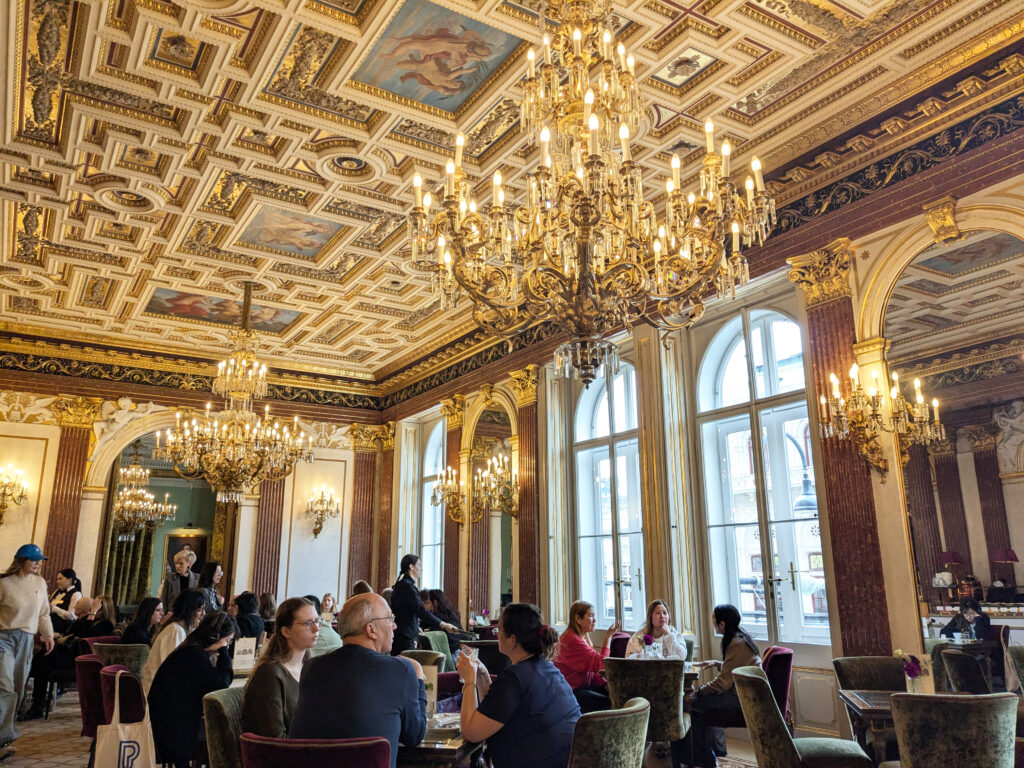
- Gerstner’s, opposite the Opera House. The ground floor is for sales of pastry to go, next floor up has small tables for coffee and cake, 3rd floor (or 2nd, if you’re counting in the European fashion) is for meals and fabulous desserts. That floor has fantastic decor (photo below). A pastry chef from Gerstner’s does a demo at Schoenbrunn of how to make Apple Strudel, the famous Viennese dessert. The timing for the demo didn’t work on our trip, but I’d love to have watched him at work.
- Morris Cafe – traditional Viennese foods. Cozy.
- Plauchutta on Neu Markt – also traditional, but a bit fancier, since it’s in a major tourist area. Open until 10 p.m.
- Chameleon, near Mozarthaus – traditional, tasty, cozy.
- Sole – Italian
Fine dining (Michelin stars) as of March 2026
- Steirereck im Stadtpark
- Amador
- Mraz & Sohn
- Silvio Nickol Gourmet Restaurant
- Konstantin Filippou
- Doubek
- Apron
- Pramer & the Wolf
Traditional / classic
- Figlmüller (or sister spot Lugeck) — Legendary for massive, crispy Wiener Schnitzel (veal or pork)—touristy but iconic.
- Plachutta — Famous for Boiled beef (2.2.1). Elegant yet traditional.
- Meissl & Schadn — Revived classic Viennese dishes in a historic setting—great for hearty fare.
- Zum Schwarzen Kameel — Historic pub with Viennese staples and charm.
- Gmoakeller (or similar old-school spots) — Cozy, historic taverns for classics like roast pork or goulash.
More
- For more Fearless Foreign Foods, see this page.