Research for a visit to Prague in March 2026, with notes after the visit. Sections: 1) History, 2) Culinary traditions, 3) Restaurants, 4) Czech pronunciation.
As of March 2026, Czechia (a.k.a. the Czech Republic) uses the korona (CZK) rather than the euro. Since we were only in Prague for 2 days, we paid for everything with a credit card rather than changing money. I recommend having a couple US$’s worth of CZKs or euros to use at public restrooms. Many restrooms have attendants rather than credit-card access. Paying for restrooms is annoying if you don’t expect it; on the other hand, I’ve never paid and found the restroom smelly or filthy. I could get used to that.
1. History
1.1 Middle ages
Prague, capital of the Czech Republic, is a millennium and a half old. The city began ca. 870-880 with construction of Prague Castle, built overlooking the Vitava River by Prince Bořivoj I of the Přemyslid dynasty. The Přemyslids ruled the land of the Boii, a.k.a. Bohemia. In the 9th century, Christianity was introduced to Bohemia by Sts. Cyril and Methodius, known as the “Apostles of the Slavs”.
From 924 or 925 to 929, Bohemia was ruled by Wenceslas I (Václav), a man famous for his generosity. You might know him from John Mason Neale’s 1853 Christmas carol.
Good King Wenceslas looked out
On the feast of Stephen,
When the snow lay round about,
Deep and crisp and even. …
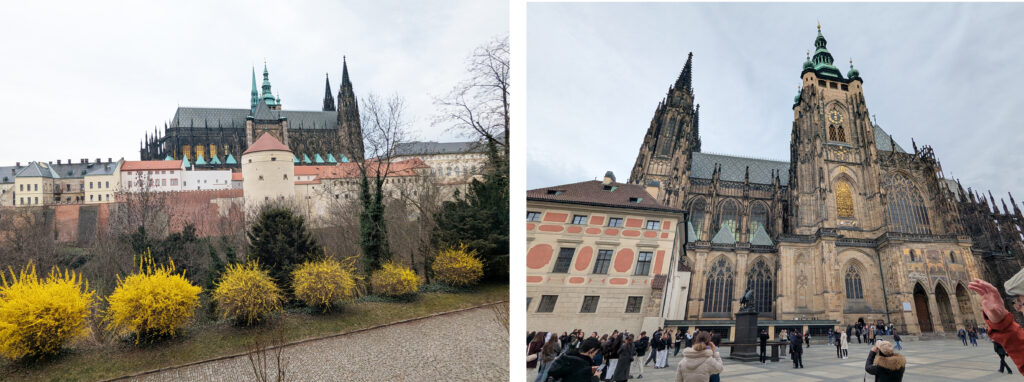
As Duke of Bohemia, Wenceslas was zealous in spreading Christianity. But after he submitted to the invading (Christian) Germans, his brother Boleslav (Boleslaus) murdered Wenceslas at the door of a church in Stará Boleslav. Wenceslas’s grave in St. Vitus Cathedral, part of Prague Castle, became a popular pilgrimage site during the Middle Ages. He has been the patron saint of Bohemia almost since his death.
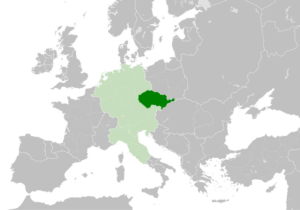
By the 12th c., Bohemia was a kingdom within the Holy Roman Empire. Although the Holy Roman Empire was a messy, constantly fluctuating conglomeration of states, during the Middle Ages the secular power of its emperor was equaled only by the spiritual authority of the pope. Prague became the de facto capital of the Holy Roman Empire in 1355, when Charles IV, a Přemyslid (King of Bohemia since 1346), was elected emperor and chose Prague as his primary residence. Charles established Charles University (University of Prague), the first university in Central Europe, built the iconic Charles Bridge (1357), and began construction of St. Vitus Cathedral. At this period, Prague was one of Europe’s cultural and economic centers.
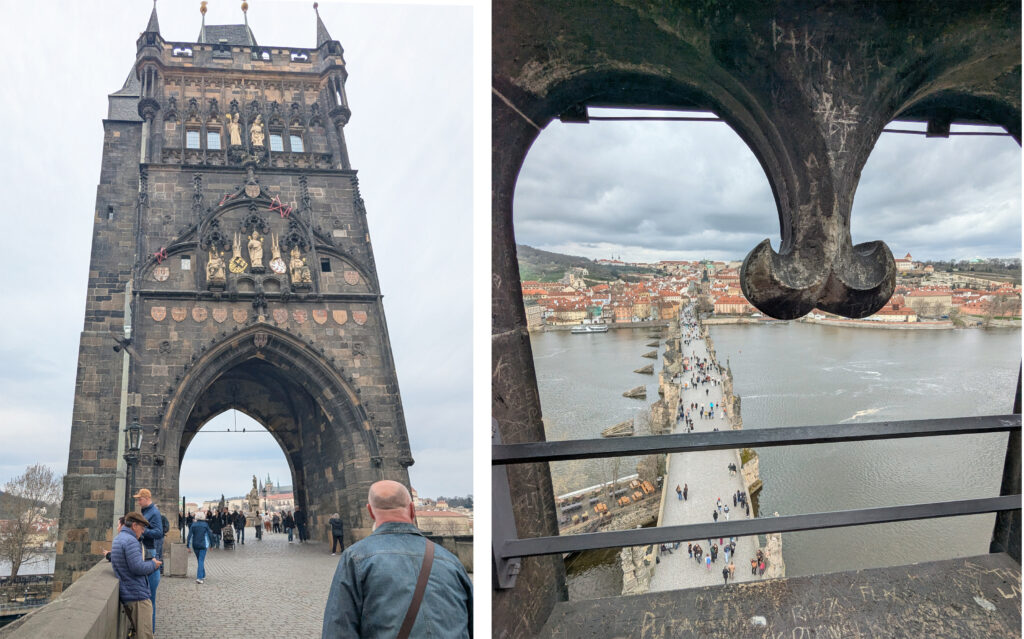
This is the Old Tower, which has a view from its top of the Charles Bridge and the far side of the Vitava River, where Prague Castle sits. As towers go, this is easy to climb, because the steps are rectangular (not pie-shaped), with a landing at each corner. If you arrive within an hour of opening, you get half-price admission.
1.2 15th to 19th centuries
Jan Hus (ca. 1370-1415) was one of a series of early reformers of the Catholic Church, anticipating by a century Martin Luther, whose 95 Theses (1517) kicked off the Reformation. A native of Bohemia, Hus graduated from Prague University, taught there, and preached in Czech (rather than Latin) at Prague’s Bethlehem Chapel. He called for reform of the Roman Catholic clergy, opposed the sale of indulgences, supported the doctrine of predestination, and argued that biblical authority takes precedence over the Church’s statements.
Meanwhile, starting in 1409, three men were claiming to be head of the Catholic Church. This is known as the “Western Schism”. The Council of Constance (1414-1418) settled the claims of those rival popes. It also convicted of heresy Jan Hus, who had attended the Council under promise of safe-conduct. On July 6, 1415, Hus was burned at the stake.
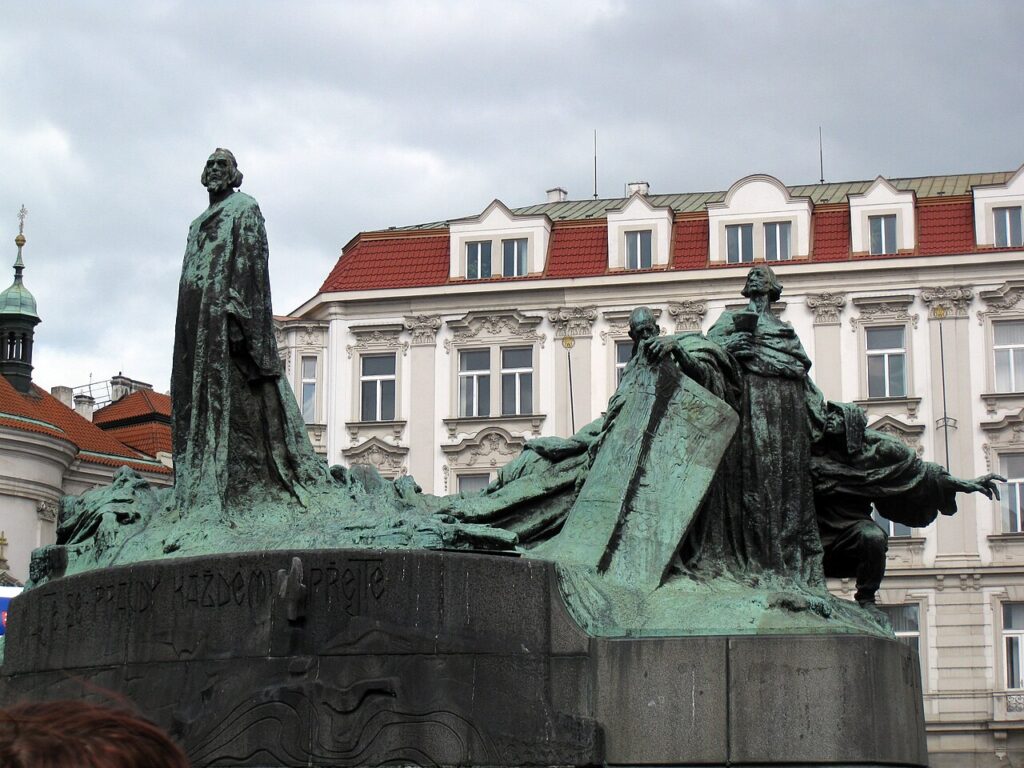
In 1419, some of Hus’s followers threw Catholic councilors out of windows in the New Town Hall. The First Defenestration of Prague kicked off the Hussite Wars. Hussites demanded freedom of preaching, expropriation of church property, and punishment of egregious sinners. Pope Martin V called five crusades against them, but the wars ended in 1436 via compromise rather than defeat. For almost 200 years, the Bohemian Catholic Church was associated with, but independent of, the Catholic Church headed by the pope. Old Town Square in Prague has a sculpture honoring the Hussites.
In 1526 the Habsburgs incorporated Prague and Bohemia into the Habsburg monarchy, where it remained for almost 400 years. But Protestant Bohemians resented attempts by the Habsburgs to reimpose Catholicism. On 5/23/1618, Protestant nobles threw three Catholic officials out the windows of Prague Castle: the Second Defenestration of Prague. This set off the Bohemian Revolt and was the trigger for the Thirty Years’ War (1618-1648), a Europe-wide conflagration. The Thirty Years’ War began as a conflict of Protestants vs. Catholics, but evolved into a battle of dynasties: the Bourbons of France vs. the Habsburgs of Spain and the Holy Roman Empire. In the 1620s, Bohemia was forcibly Catholicized. Although the Habsburgs constructed numerous buildings in Prague in the Baroque style, Prague’s fortunes declined after the 1620s.
The four historic towns of Prague – Hradčany, Malá Strana, Old Town, New Town – were unified in 1784.
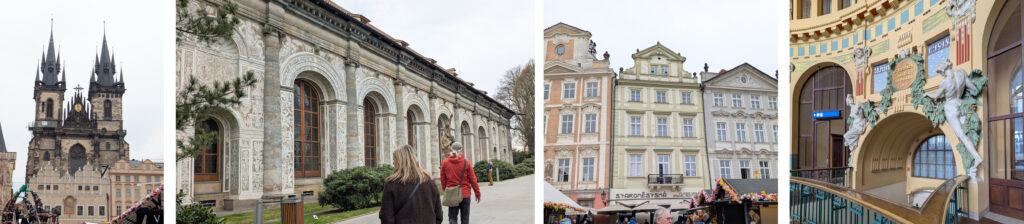
Prague’s nickname is “City of a Hundred Spires”, which range from Romanesque (10th c.) to Gothic, Renaissance, Baroque, and modern – mostly on churches but also on castles. Walk around a corner in Prague and you never know what century’s architecture you’ll see, from 12th to 20th.
1.3 20th century
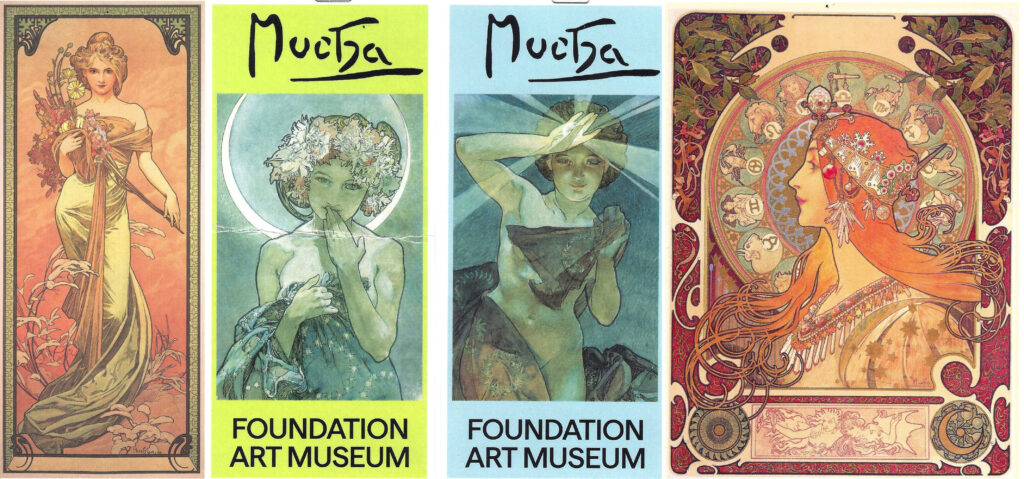
The Czech artist I’m most familiar with is Alphonse Mucha (1860-1939), whose Art Nouveau posters and paintings are world famous. The Mucha Foundation has a lovely small museum in Prague, in an 18th-c. palace. The gift shop pffers high-quality reproductions.
On 10/28/1918, Prague became the capital of the new nation of Czechoslovakia, established when the Austro-Hungarian Empire was disbanded following World War 1. In World War 2, the city was occupied by the Nazis, but (unlike Dresden, for example) suffered little physical damage. The Communists took power in Czechoslovakia in February 1948, via a bloodless coup d’état after the Communists infiltrated the government and security forces, purging non-communists.
In 1968, with the Prague Spring movement, Czechs demanded more freedom and reform of the government. The movement was crushed by Russian tanks and half a million troops.
In November 1989, hundreds of thousands of peaceful protesters set off the Velvet Revolution in Prague. The Communist government relinquished power in early December, and Czechoslovakia followed Poland, Hungary, and East Germany in becoming free of the domination of the USSR. On 12/31/1992, the country split peacefully into the Czech Republic and Slovakia (the Velvet Divorce), with Prague as the capital of Czechia (a.k.a. the Czech Republic). Czechia joined the EU in 2004.
Because we were only in Prague for 2 days and didn’t know the language, on the first day we booked at 6-hour tour through Viator. It included lunch, a river cruise, and a tour with a very knowledgeable guide of the major sights: Prague Castle, St. Vitus Cathedral, Old Town Square, Charles Bridge, the Prague Astronomical Clock, several World War 2 memorials, the Jewish Quarter, and more. We loved that tour. Based on it, we’d be happy to spend more time in Prague. It’s a large and dense city compared to Dresden, but very walkable.
Music
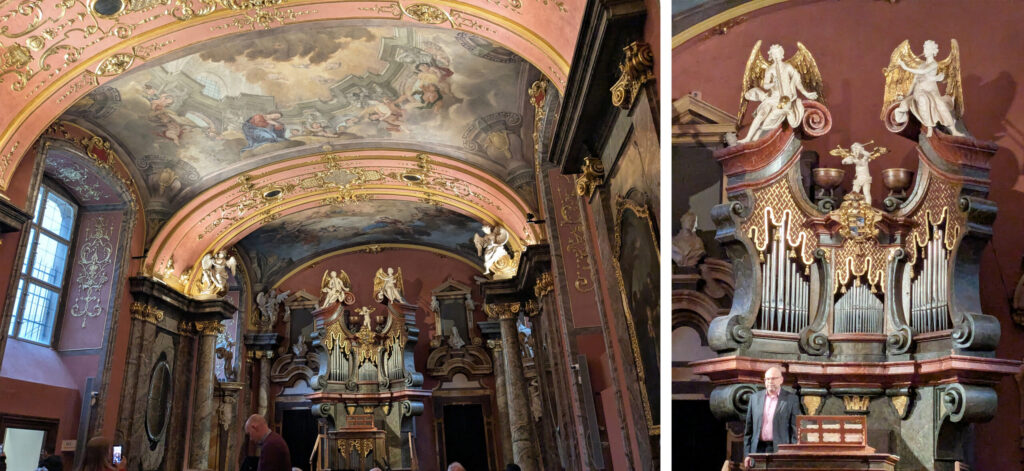
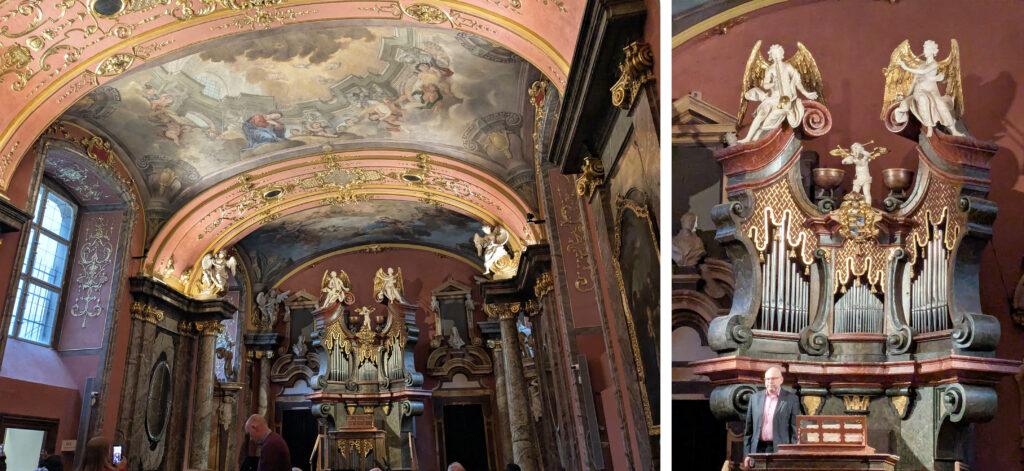
The other highlight of the Prague visit was a concert in the Mirror Chapel at the Clementinum, a gorgeously decorated Baroque space with terrific acoustics. Performers included a string sextet, an organist, and a soprano. On the program: Vivaldi, Mozart, Pachelbel, Verdi, Dvorak, Bach, Smetana, Beethoven.
2. Culinary traditions
2.1 Typical & unusual ingredients
The food in Prague (and all of Czechia) tends to be hearty comfort food, influenced by yet distinct from other German, Austrian, Hungarian, and other Central European cuisine. Some favorite Czech foods:
Cabbage
As sauerkraut (kysané zelí), often braised or stewed, including in sauerkraut soup (2.2.2). Also served fresh.
Cheese
Tvaroh is curd cheese, like German Quark. The usual substitute is 9 parts ricotta and 1 part sour cream.
Dumplings: knedlíky
Made from bread (houskové knedlíky from old bread, flour, milk, eggs), potatoes (bramborové knedlíky), or flour.
Herbs & spices
Caraway seeds (kmín), marjoram, garlic, dill, bay leaves, allspice, and paprika (sweet, not hot).
Pickled foods
Sausages, veggies, or cheese (2.2.3).
Pork
The favorite meat, including shoulder or knuckles (2.2.1), smoked Prague ham (2.2.3), blood sausages, etc.
Potatoes
In soups (2.2.2), salads, pancakes (2.2.3), and dumplings (2.2.1).
Root vegetables
Carrots, parsley root, celery root, onions, turnips, leeks – stewed, pureed into sauces (2.2.1), or added to soups (2.2.2).
Sour cream and vinegar sauce
Sour cream and vinegar feature in tangy cream sauces (kulajda or dill sauce). Same sort of sauce in sour lentils (čočka na kyselo).
2.2 Classic dishes
2.2.1 Entrees
Beef tenderloin with root vegetable sauce: Svíčková na smetaně
Marinated beef tenderloin, roasted and sliced, in creamy root vegetable sauce (carrots, celery root, parsley), topped with cranberries and/or lemon and sometimes whipped cream (!). The most elegant classic Czech entrée. I’ve tried this: it was very tasty.
Duck, roasted or confit: Pečená kachna
Whole or leg, crispy skin, served with red cabbage and dumplings.
Goulash: Guláš
Beef or pork stew, slow cooked with onions, paprika, caraway, and marjoram; dumplings to soak up the sauce. The purest version has no tomatoes.
Pork with dumplings and sauerkraut: Vepřo-knedlo-zelo
Pork (often shoulder or knuckle) slow roasted with garlic or caraway, served with fluffy bread or potato dumplings and braised sauerkraut. The unofficial national dish, popular in beer halls & pubs.
Schnitzel: Řízek
Pork or veal cutlet, breaded and fried, served with potato salad or fries.
2.2.2 Soups
Beef broth: Hovězí vývar
Clear broth with liver dumplings, noodles, or root vegetables. Often served at weddings or other festivities.
Garlic soup: Česnečka
Broth-based soup with minced or crushed garlic, marjoram and/or caraway, potatoes, topped with croutons. Famous as a hangover cure or for a cold. Ubiquitous in pubs. My husband, who grew up in an Italian family where garlic is much beloved, really enjoyed this.
Goulash soup: Gulášová polévka
Soupier version of beef or pork stew (Entrees), with lots of onions, paprika, caraway, marjoram, and garlic, often with bread or dumplings to soak up the sauce. Mild spices.
Mushroom potato soup: Kulajda
Creamy mushroom-potato soup with dill, vinegar, and a poached egg. Sometimes caraway or sour cream.
Pea soup: Hrachová polévka
Thick split pea soup with smoked meats, with Czech seasoning.
Potato soup: Bramboračka
Hearty potato soup (sometimes thickened with roux) with carrots, parsley root, celebery, onions, garlic; often with smoked meats or sausage, mushrooms and/or caraway.
Sauerkraut soup: Zelňačka
Tangy, with sauerkraut, potatoes, smoked meat, onioins, caraway, paprika.
Tripe soup: Dršťková polévka
Tripe in broth with roux, paprika, and garlic. A traditional favorite.
2.2.3 Snacks
Usually savory rather than sweet, good with beer.
Beef tartare: Tatarák
Raw beef with onions, capers, egg yolk, and spices, often served with toast.
Fried cheese: Smažený sýr
Edam or similar cheese, breaded and deep fried so it’s crispy outside, creamy inside. Served with tartar sauce and fries or potatoes.
Fried dough: Langoš
Topped with garlic cheese, ketchup, or sour cream. Street food.
Marinated cheese: Nakládaný hermelín
Soft cheese such as Camembert marinated in oil, with garlic, onions, peppers, and herbs. Creamy and spicy.
Olomouc curd cheese: Olomoucké tvarůžky
Pungent fermented cheese, marinated or served plain. A Czech “stinky cheese.”
Pickled sausages: Utopenec
Sausages soaked in vinegar, with onions, peppers, and spices.
Potato pancakes: Bramboráky
Crispy grated potato pancakes with garlic, marjoram, and/or caraway. Sometimes topped with cheese.
Prague ham slices: Pražská šunka
Served with horseradish or mustard.
Sandwiches: Chlebíčky
Open-faced sandwiches on buttered bread, topped with ham, cheese, egg, veggies, or spreads.
Sausages: Vuřty / klobásy
Grilled or beer-braised. Often in dark beer or with mustard and onions. Also served as street food.
2.2.4 Desserts
Chimney cake: Trdelník
Yeast dough wrapped on a stick, baked, then rolled in cinnamon sugar. Often filled with ice cream or Nutella. Street food.
Choux pastry: Větrník & Věneček
Round puff pastries. Větrník has caramel whipped cream and caramel glaze. Věneček has vanilla custard and icing.
Crepes or pancakes: Palačinky
Rolled or folded around jam, Nutella, whipped cream, or cheese, sometimes dusted with powdered sugar.
Fruit dumplings: Ovocné knedlíky
Dough pocket, boiled or steamed, filled with whole fruits; often topped with melted butter, sugar, cinnamon, grated cheese, or breadcrumbs. Sweet and hearty.
Honey cake: Medovnik
Honey-infused sponge layer cake with filled of creamy caramel or condensed milk and nuts.
Míša Cake: Míša řezy
Bars with curd cheese (tvaroh), butter cream, and chocolate glaze.
Pastries with filling: Koláče or koláčky
Round yeast pastry with indented center filled with jam, poppy seeds, curd cheese (tvaroh), or nuts.
Sponge fruit cake: Bublanina
Light sponge cake with fruit (cherries, plums) in the batter.
Strudel: Štrúdl
Flaky pastry filled with apples, poppy seeds, or cherries.
2.2.5 Beverages
Non-alcoholic beverages
- Kofola: cola alternative, less sweet than Coke. A favorite from Communist times.
- Fruity drinks: lemonade, elderflower, raspberry, cucumber, grapefruit.
- Coffee: strong espresso or Turkish style.
Beers (Pivo)
The Czech Republic has the world’s highest per capita beer consumption. “Cheers!” = “Na zdraví!”
Czech beers are often pale lagers (pilsners) such as Pilsner Urquell, Staropramen (made in Prague), Budweiser Budvar (NOT the American one), Bernard, Krušovice, and Gambrinus.
Herbal liqueurs
- Becherovka: bittersweet, spiced with cinnamon, clove, and anise. Served chilled as digestif, or in cocktails.
- Fernet: bitter herbal.
- Absinthe: Czech version.
Mead: Medovina
Honey wine, sometimes served warm.
Mulled wine: Svařák
Red wine with cinnamon, cloves, and citrus. Similar but with brandy: punch (Punč).
Plum brandy: Slivovice
45-52% proof, often homemade or from Moravia.
Wine: Vino
Often from southern Moravia, white or red, often young or sweetish.
2.3 For those with specific tastes or needs
2.3.1 For the meek
Czech food isn’t generally spicy, although caraway and paprika have a mild heat.
- Entrees (2.2.1) Beef tenderloin in cream sauce, Pork with dumplings & sauerkraut, Duck, Schnitzel,.
- Soups (2.2.2): Potato mushroom, Garlic.
- Snacks (2.2.3): Fried cheese, Sandwiches, Marinated cheese, Potato pancakes.
- Desserts (2.2.4): none are spicy.
2.3.2 For the bold
- Entrees: Goulash, Pork with dumplings and sauerkraut, Duck (all 2.2.1), Beef tartare (2.2.3).
- Soups (2.2.2): Garlic, Mushroom-potato
- Snacks (2.2.3): Marinated cheese, Pickled sausages, Olomouc curd cheese
2.3.3 Diabetic
Meals usually come with starchy side dishes such as dumplings, potatoes, or bread. Ask for extra cabbage instead. The main dishes are usually lower in carbs. In grocery stores, the diabetic section is dia potraviny.
- Entrees (2.2.1): Beef tenderloin in cream sauce, Duck, Pork with dumplings and sauerkraut, Schnitzel (ask for grilled = grilované), Goulash (ask for it without dumplings)
- Soups (2.2.2): Mushroom-potato, Garlic, Sauerkraut
- Snacks (2.2.3): Prague ham, Marinated cheese
2.3.4 Low fat
Traditional cuisine tends to be rich; ask for leaner protein or broth-based sauce. Without cream = bez smetany. Grilled = grilované. Without fat = bez tuku.
- Entrees: grilled chicken (kuře na grilu), turkey (krůta), or lean beef (hovězí), fish. Sides: sauerkraut or pickled veggies.
- Soups (2.2.2): Garlic, Beef broth, Sauerkraut. Also: lentils with boiled egg (Čočka s vejcem), vegetable stew (Léko).
2.3.5 Vegetarian
Without meat = bez masa. Vegetarian = vegetariánské.
- Entrees: see Fried cheese and Potato pancakes (2.2.3).
- Soups (2.2.2): Mushroom potato, Garlic
- Snacks: see Fruit dumplings (2.2.4), Fried dough (2.2.3).
3. Restaurants
AVOID tourist traps on Old Town Square. Our tour guide took us to one there, because his company had negotiated a substantial discount. He told us that without the discount, the prices would be outrageous.
3.1 Restaurant terms
- Pubs: hospody
- Traditional restaurants include Lokál chain
- Patisseries = cukrárny
3.2 Restaurants we ate at
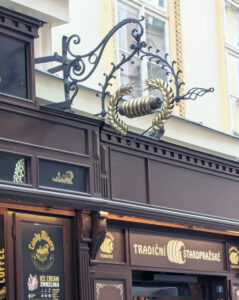
- Staroměstská on Old Town Square, while on the Viator tour.
- We stayed (with rewards points) at the Prague Atrium Hilton. It’s what I think of as a “Hilton Humongous”, a convention hotel full of amenities. You could stay there for a week and not realize you were in a foreign country. We ate at the Hilton several times because there didn’t seem to be any other restaurants nearby; but we weren’t impressed with the quality or prices.
3.2 Michelin rated (all 1 star) – from online research in March 2026
- Field: Modern cuisine with seasonal, local produce. Known for creative dishes and excellent service.
- La Degustation Bohême Bourgeoise: Contemporary take on Bohemian (Czech) classics, featuring tasting menus and an open kitchen.
- Levitate: Innovative fusion blending Czech ingredients with Asian spices and Nordic techniques. Praised for its unique flavors.
- Štangl: Modern cuisine focused on sustainability.
- Casa De Carli: Italian fine dining, emphasizing authentic ingredients and elegant presentations. Cozy setting.
3.3 Bib Gourmand Restaurants – from online research in March 2026
According to Grok, these offer high-quality meals at value-for-money prices (typically €€ or under).
- Alma: contemporary cuisine with creative, seasonal dishes.
- Na Kopci: Classic Czech elements with a modern twist.
- The Eatery: Czech dishes, emphasizing nose-to-tail cooking and local sourcing.
- U Kalendů: Czech home-style meals, including sourdough-based innovations. Goulash.
- U Matěje: Czech cuisine in a casual setting.
- Výčep: Czech pub-style eats at a budget-friendly price (€).
- Dejvická 34 by Tomáš Černý: Italian, focusing on fresh pastas and regional specialties.
3.4 Other restaurants mentioned by Grok – from research in March 2026
- For goulash: Mincovna
- Upscale: Café Imperial, for Beef sirloin in cream sauce or for traditional pastries.
- For duck confit: Hospoda Hajnakova or U Bansethu
- Traditional pastries: Cukrárna Myšák
4. Czech pronunciation
This is copy-pasted from Grok, the AI of x/Twitter.
The short version of the rules: the accent is usually on the first syllable of the word. A hook over a consonant usually makes the sound aspirated: “s” is pronounced as in “sun”, š is “sh” as in “ship”. “T” becomes “th”, etc. The ř, notoriously difficult for foreigners, is a rolled “rzh” sound, like the “r” in Dvorak. (Yes, he’s Czech.)
4.1 General rules
- The Czech alphabet (abeceda) consists of 42 letters, based on the Latin script with added diacritics (háček ˇ for “hook,” čárka ´ for length, and kroužek ° for ring on ů). Czech is highly phonetic—each letter (or digraph like ch) has a consistent sound, unlike English.
- Stress is always on the first syllable of a word.
- Vowels come in short and long pairs (long ones marked with ´ or °, and they are held longer but don’t change quality drastically).
- Consonants include some unique or tricky sounds for English speakers, like ř (a famous rolled “rzh” sound), ch (guttural like Scottish “loch”), and palatalized ones (softened by following i/í/ě).
4.2 Vowels
- A a — /a/ like “a” in “father” or “ah” (short)
- Á á — /aː/ longer version of above (like “aa” in “spa”)
- E e — /ɛ/ like “e” in “bet” or “get”
- É é — /ɛː/ longer “eh” (like “air” without r)
- Ě ě — /ɛ/ or /je/ after consonants; softens preceding consonant + “ye” like in “yesterday” (e.g., dělat = “dyelat”)
- I i — /ɪ/ like “i” in “bit” or “sit”
- Í í — /iː/ longer “ee” like in “machine”
- o — /o/ like “o” in “or” but shorter (no diphthong)
- Ó ó — /oː/ longer “oh”
- U u — /u/ like “oo” in “book” or “stool” (but shorter)
- Ú ú — /uː/ longer “oo” like in “food”
- Ů ů — /uː/ same as ú (used in different positions)
- Y y — /ɪ/ identical to short i (but hardens preceding consonant)
- Ý ý — /iː/ identical to long í (hard version)
Note: i/í “soften” preceding consonants (make them palatalized), while y/ý keep them “hard.”
4.3 Consonants (focus on differences from English)
- B b — /b/ as in “bat”
- C c — /ts/ like “ts” in “cats” or “pizza” (never “k”)
- Č č — /tʃ/ like “ch” in “church” or “cheese”
- D d — /d/ as in “dog”
- Ď ď — /ɟ/ soft “d” like “du” in “duke” (British) or palatal “dy”
- F f — /f/ as in “fun”
- G g — /ɡ/ as in “go” (rare in native words)
- H h — /ɦ/ voiced “h” like a soft gargle (between “h” and breathy “g”)
- CH ch — /x/ guttural “ch” like Scottish “loch” or German “Bach” (digraph, treated as one letter)
- J j — /j/ like “y” in “yes” or “yellow” (never “j” as in “judge”)
- K k — /k/ as in “cat”
- L l — /l/ as in “love”
- M m — /m/ as in “man”
- N n — /n/ as in “no”
- Ň ň — /ɲ/ like “ny” in “canyon” or Spanish “ñ”
- P p — /p/ as in “pen”
- Q q — /kv/ or rare, mostly in foreign words
- R r — /r/ rolled/trilled like Spanish “rr” (single tap often)
- Ř ř — /r̝/ unique Czech sound: trilled r + zh (like rolled “rzh” or growling “ř” — hardest for foreigners; think French “j” + rolled r). Think of that unusual sound you hear in the name of the composer Dvorak: his name is spelled Dvořak.
- S s — /s/ as in “sun”
- Š š — /ʃ/ like “sh” in “ship”
- T t — /t/ as in “top”
- Ť ť — /c/ soft “t” like “ty” in “tune” (palatal)
- V v — /v/ as in “victory”
- W w — /v/ in foreign words (like “v”)
- X x — /ks/ as in “box”
- Z z — /z/ as in “zoo”
- Ž ž — /ʒ/ like “s” in “pleasure” or “zh” in “measure”
The alphabet order (for sorting/dictionaries): a á b c č d ď e é ě f g h ch i í j k l m n ň o ó p q r ř s š t ť u ú ů v w x y ý z ž.
More
- For other Fearless Foreign Food essays, see here.