Research for a visit in March 2026, with notes after the visit: 1) brief history of Dresden and Saxony, and what to see there; 2) what to eat and recommended restaurants. Fair warning: I love art and history. My list of Must-See Items reflects that.
1. History of Dresden
1.1 Ancient times
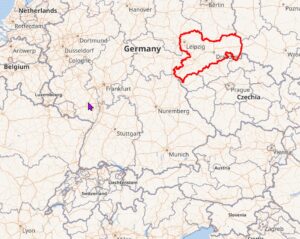
Dresden, on the Elbe River in eastern Germany (near the borders of Czechia and Poland), is the capital of Saxony. Saxons first appeared in the historical record when they attacked the Roman frontier in the 2nd century AD. Their name was derived from their weapon of choice, the seax (short sword). Saxons were hired as mercenaries by the Romans, and by English rulers of the early Middle Ages.
In the 5th-8th centuries, many Saxons migrated (uninvited) to England. Hence the medieval English were known as “Anglo-Saxons”, which continues in use today in phrases such as WASP (White Anglo-Saxon Protestant).
1.2 Middle Ages and Renaissance
The Saxons who remained in continental Europe were conquered by Charlemagne in a series of brutal wars (772-804). He forced them to become part of his Frankish Empire and made them convert to Christianity. The town of Dresden (which means “Forest Dwellers on the Plain”) is first mentioned in 1206. Over the next couple centuries, Saxony was frequently deconstructed and reconstructed, passing from the hands of the margraves of Meissen to the kings of Bohemia and then to the margraves of Brandenburg.
By the 15th c., Saxony was a prominent territory within the Holy Roman Empire. The Empire was a hodge-podge of German-speaking territories, some ruled directly by the emperor, some quasi-independent. Saxony’s ruler was one of 7 prince-electors who voted for the next Holy Roman Emperor.
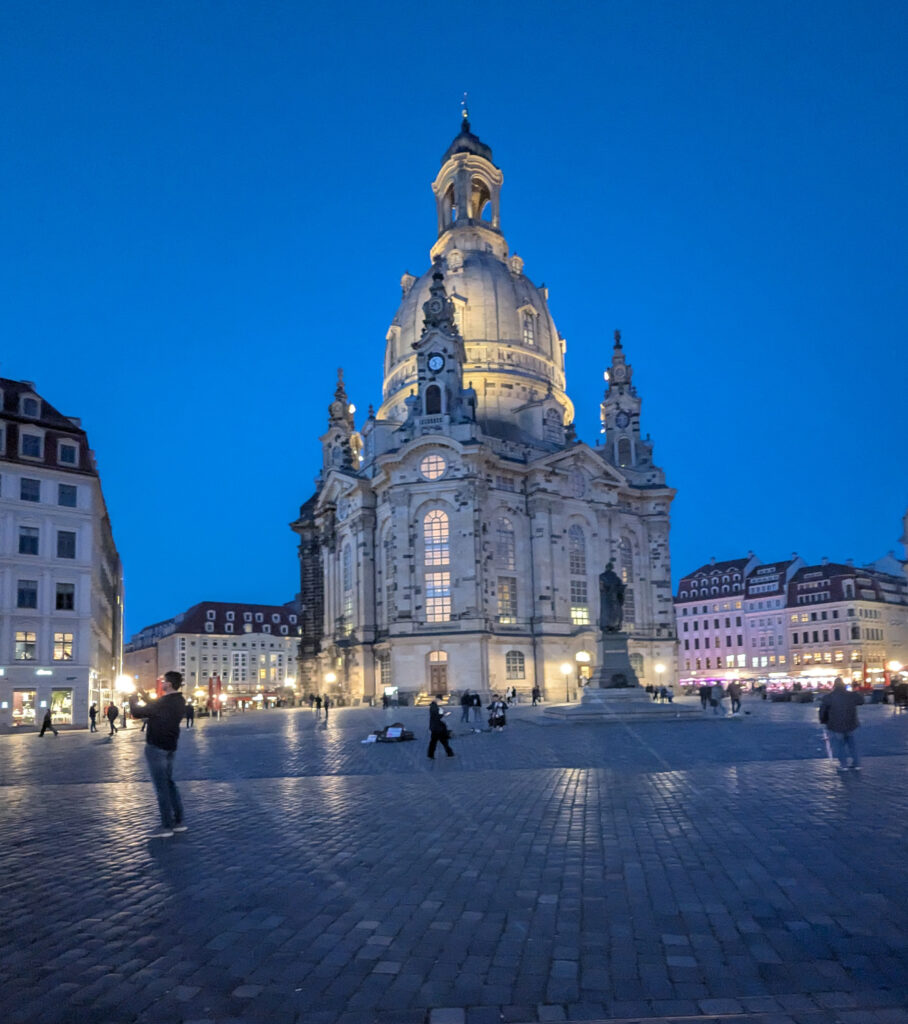
On Oct. 31, 1517, Martin Luther posted his 95 Theses in Wittenberg, a university town in Saxony. He was granted protection from the wrath of the pope and the Catholic Church by the Elector of Saxony. Hence Saxony became a leading center of the Reformation. The Frauenkirche, Dresden’s iconic church, has the Baroque flair associated with Catholic churches, but it is in fact Lutheran.
1.3 18th century: Augustus II the Strong
In the early 18th century, under Augustus II the Strong, Dresden emerged from its sleepy small-town status. Augustus was elector of Saxony from 1694 until his death in 1733. This brought him substantial income, since Saxony had thriving mining and trade. Augustus was also king of Poland (1697-1733), which brought him even more income. As a side hustle, he collected income from the Meissen porcelain factory, established in 1710. Until 1718 Meissen was the sole European manufacturer of porcelain. Even after others stole the secret to porcelain’s manufacture, Meissen was in high demand for its superb quality.
So when Augustus decided to construct not one, not two, but multiple palaces in Dresden, his capital city, he had plenty of wherewithal. And he had a style in mind, too. In 1687, as a young man on his Grand Tour, Augustus visited France. There he was wowed by the palace and gardens of Versailles that Louis XIV had begun constructing in the Baroque style in 1661. All Augustus’s palaces are in the Baroque style.
Here are the major palaces constructed by Augustus II the Strong in Dresden.
1.3.1 Residenzschloss
In 1701, the royal residence in Dresden was destroyed by fire. The new Residenzschloss became the primary official residence of Augustus and his court. The bombing of Dresden in 1945 left the Residenzschloss a mere shell, but it’s being systematically and accurately restored. It now houses the Dresden State Art Collections, including:
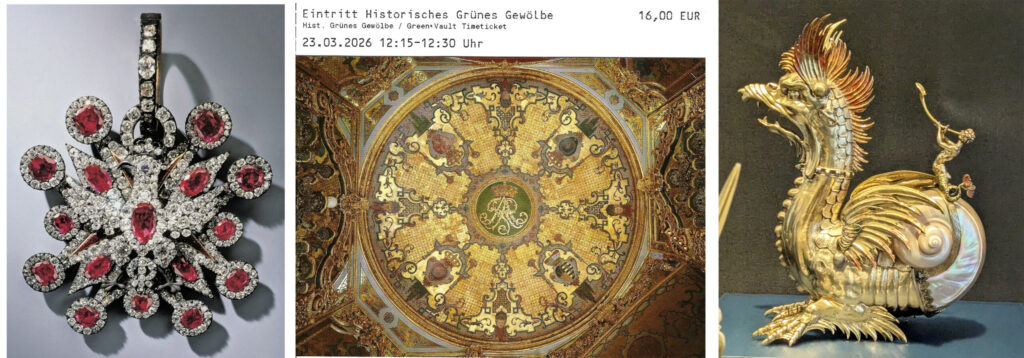
- Grünes Gewölbe (Green Vault) displays Augustus’s precious objects and jewelry as they were displayed in his time. The mirrored walls and elaborate wooden scrolling are amazing – they’re the reason you should visit the historical Green Vault. Note that you will need a timed ticket for entry. Most people use the audio guide (the old kind that you hold up to your ear, rather than downloading on your phone), and the tour can take up to 2 hours if you take your time and compare favorites with companions. Near the entrance is a display of the Green Vault after the bombing of Dresden and the steps they had to take to recreate the rooms, the trim, the frescoes, mirrors, etc. Memorable: the ivory room, a box with scads of silver filigree, ostrich figurines made of ostrich eggs, a room full of jewels, and a gold drinking cup that belong to Ivan the Terrible, and sports 2 large sapphires, elegant cloisonné work, and an inscription: “I took your gold and it’s mine now.” No photos are allowed in the Green Vault, which is a pity because the Residenzschloss doesn’t offer much in the way of postcards, either.
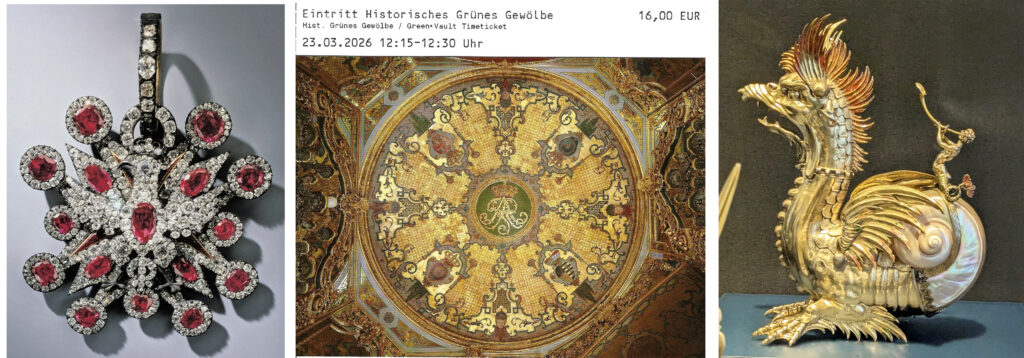
- A newer section of the Green Vault has at least as many gorgeous, precious items as the historical Green Vault, but they’re displayed in the modern museum style. Photos are allowed. Closely related: rooms full of items from the rulers’ Cabinet of Wonders, such as mother-of-pearl gaming boards, decorative items with nautilus shells, gold, silver, crystal, ivory.
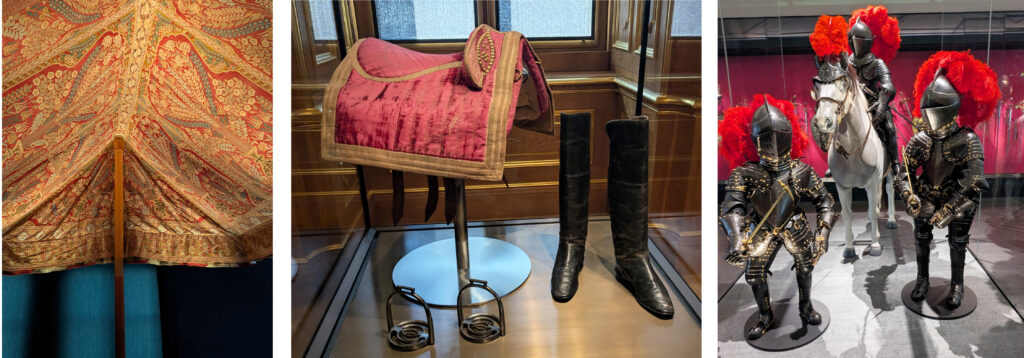
- Rüstkammer (Armoury) is full of armor and weapons, including some weapons and army tents made or inspired by the Ottoman Turks. For centuries the Ottomans were a deathly threat to Vienna, but by Augustus II’s time, they were merely exotic. This section also has a pair of Napoleon’s boots, which I was weirdly thrilled to see, and a set of flamboyant matching armor for princes ages 10, 7, and 3 (?).
- Münzkabinett (Numismatic Cabinet / Coin Cabinet), with almost 300,000 coins.
- Kupferstich-Kabinett (Cabinet of Prints, Drawings and Photographs) – closed when I was there.
- Royal State Apartments (Paraderäume), including throne room, state bedchamber, audience chamber, and the small ballroom (!), gorgeously gilded.
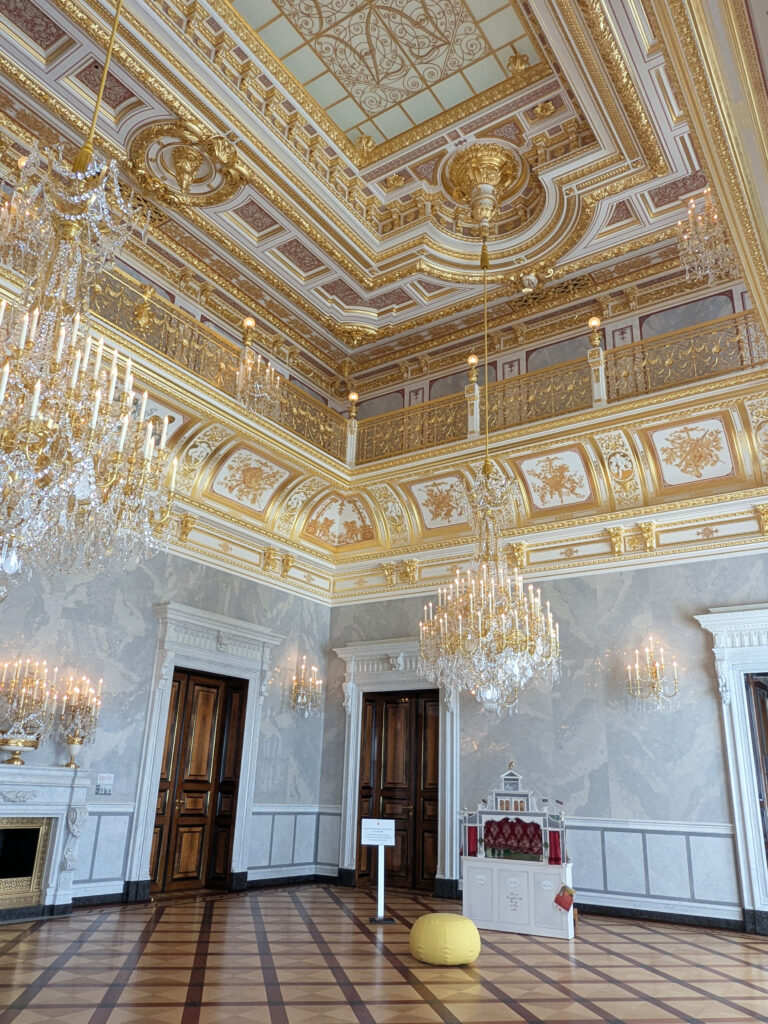
- Wardrobe rooms: dress as a status symbol. The Habsburgs must have been pack rats.
- Chapel was closed, but from the wardrobe rooms, you can see the intricate ceiling.
- Hausmannsturm (tower): panoramic views if you’re willing to climb 327 steps. The Tower doesn’t open until the end of March, so we climbed the Frauenkirche tower instead (see below).
1.3.2 The Zwinger
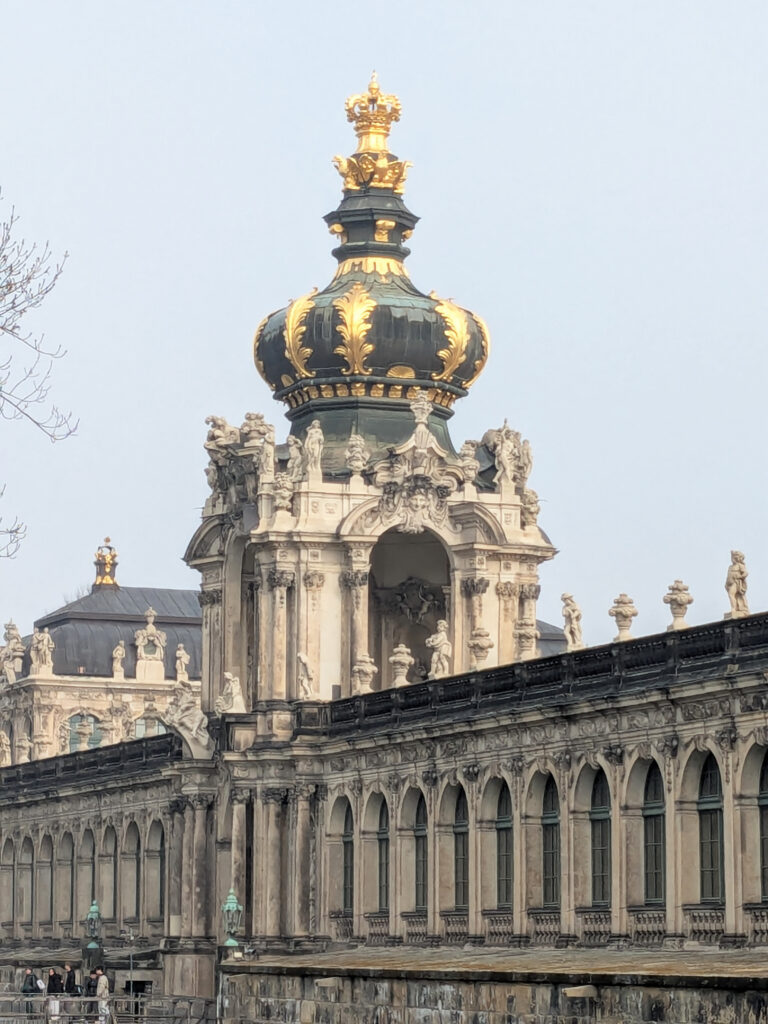
The pavilions, galleries, and courtyards of this Saxon royal palace, begun 1709, were designed for festivals and tournaments. The main entrance has a beautiful green-and-gilt dome. At sunset, it’s lovely to stroll on the upper level of the Zwinger.
The Zwinger includes:
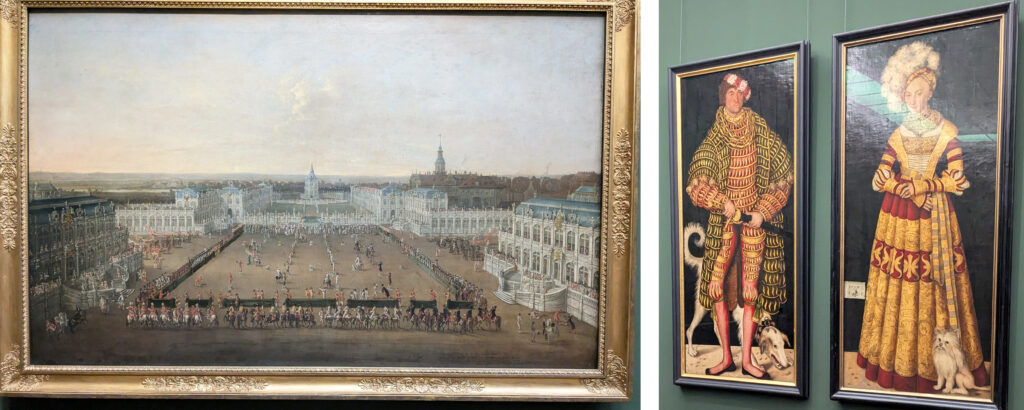
- Gemäldegalerie Alte Meister (Old Masters Picture Gallery), in the Semperbau (Semper Building). It houses Renaissance and Baroque masterpieces by Raphael (Sistine Madonna), Titian, Rembrandt, Rubens, Vermeer, Giorgione, and more. One of the most memorable sets of paintings, by Bellotto, shows Dresden as it looked nearly 300 years ago. Because our friend Augustus imposed strict rules about building in central Dresden, the city still looks a lot like Bellotto’s paintings.
- Skulpturensammlung bis 1800 (Sculpture Collection up to 1800) – I didn’t have time to visit this.
- Porzellansammlung (Porcelain Collection), with Chinese, Japanese, and especially Meissen porcelain from Augustus’s collection, including figurines, vases, animal sculptures from the “Menagerie,” and decorative objects. I didn’t have time to visit this.
- Mathematisch-Physikalischer Salon (Royal Cabinet of Mathematical and Physical Instruments), est. 1728, with historical instruments for astronomy, timekeeping, surveying, and physics, such as globes, clocks, telescopes, calculating machines. And yet again, I didn’t have time to visit this.
1.3.3 Pillnitz Palace
The Pillnitz is a summer residence on the Elbe, about 10 miles outside the city. In the 1720s, Augustus transformed it into a Baroque pleasure palace with Chinoiserie details. The main building, burned in 1818, was replaced with the Neues Palais (New Palace), in classical style. You can get to Pillnitz by riding a tram from central Dresden, then walking from the end of the tramline to the ferry. The ferry takes 5 minutes, and then there’s an easy 5-minute walk to Pillnitz. Near the ferry is a Biergarten, perfect for lunch.
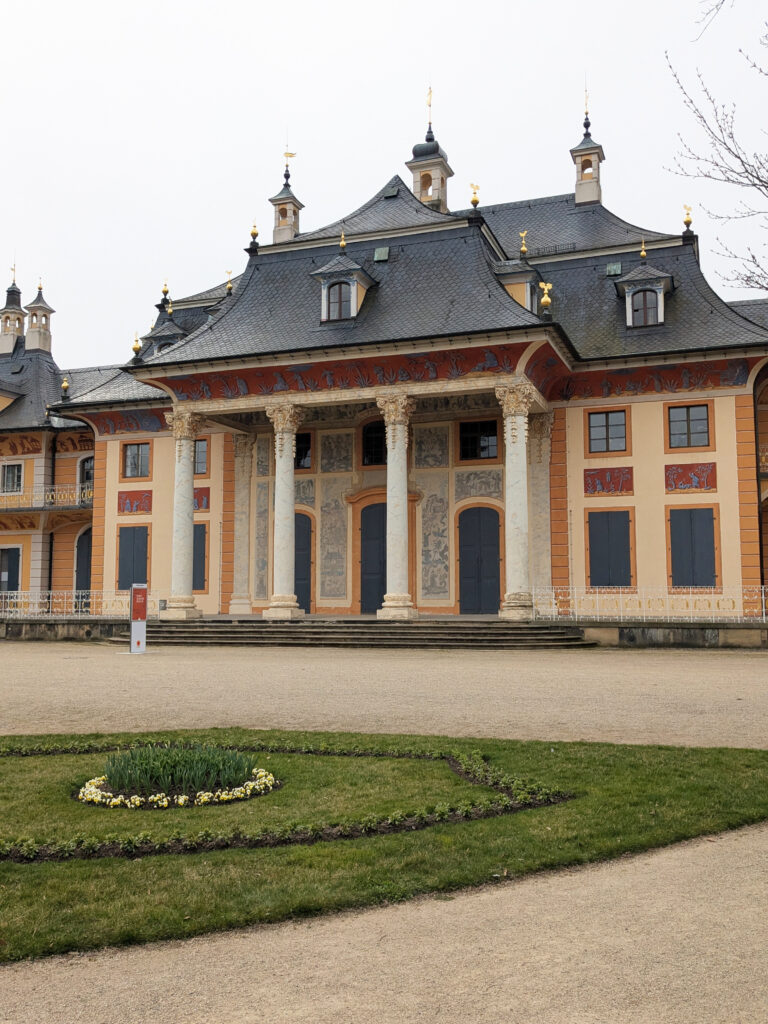
At Pillnitz:
- Palace Museum, highlighting the lives of the monarchs. The Pillnitz buildings weren’t yet open for the season in mid-March, when I was there.
- Kunstgewerbemuseum (Museum of Decorative Arts / Arts and Crafts Museum), with furniture, textiles, ceramics, glass, metalwork, etc. – CLOSED FOR RENOVATION as of early 2026.
- Gardens and greenhouses: open year round.
- Ceramic shop beneath one of the main buildings, on the side facing the Elbe, has some charming pieces.
- Don’t miss the markers for the levels of flooding on the Elbe side of the palace, near the ceramic shop. That is one unruly river.
1.3.4 Japanese Palace
This was a pleasure palace on the Elbe, acquired by Augustus ca. 1717-1719, rebuilt and expanded to display his collection of Chinese, Japanese, and Meissen porcelain. The display areas were not completed: Augustus’s porcelain collection is instead housed in the Zwinger (see above). Today the Japanese Palace houses the Museum für Völkerkunde Dresden (Dresden Museum of Ethnology / State Ethnographic Collections), covering ethnology from Africa, Asia, Oceania, and the Americas, emphasizing cultural exchange and postcolonial perspectives.
1.3.5 Central Dresden
Augustus imposed rules for construction within Dresden’s city center, aiming to make it cohesive and uniformly beautiful. The Frauenkirche, Dresden’s iconic church (photo above), is in Augustus’s favored Baroque style. It was not commissioned by him, however, since he had converted from Lutheran to Catholic in order to become King of Poland.
Many German cities are known for their Baroque architecture, but none surpasses Dresden in the number of palaces and the unified feel of its city center. For years it was known as “Florence on the Elbe”. The view from 18th-c. Bruhl Terrace, built along the river, is especially lovely at dawn and dusk.
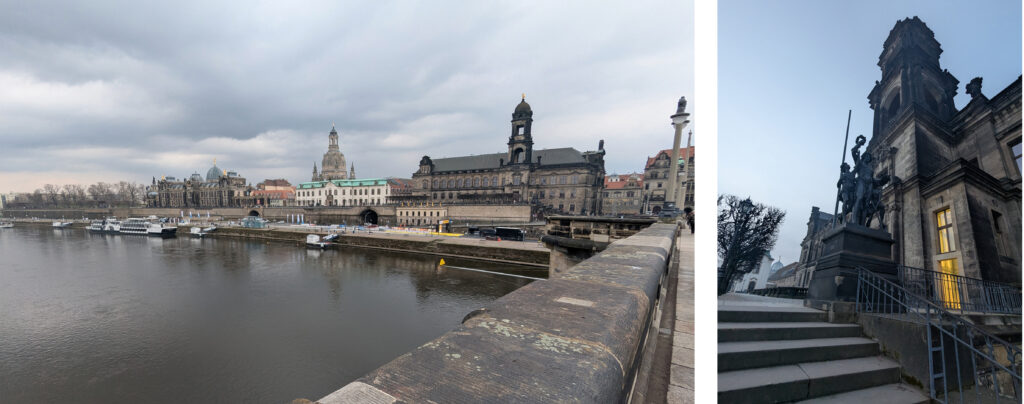
1.4 19th-20th centuries
In 1806, when Saxony allied with Napoleon, it was transformed from an electorate in the Holy Roman Empire into the Kingdom of Saxony. After Napoleon’s final defeat in 1815, it became one of 39 states in the German Confederation, which was dominated by Prussia and Austria. Saxony soon became a highly urbanized industrial center, known for manufacturing textiles and machinery. A symbol of its wealth is the Semper Oper, a world-famous Renaissance-style opera house built in 1841, destroyed by fire in 1869, rebuilt in 1878, destroyed in the 1945 bombing, rebuilt and reopened in 1985. When we were in Dresden, the Semperoper, a.k.a. Semper Opera unfortunately wasn’t offering anything we wanted to see. If I’d had more time, I’d have taken a tour of the building, at least.
The Albertinum in Dresden has one of the best collections of the works of Caspar David Friedrich – a whole roomful of them. They’re worth the price of admission, because no, a photograph is not just as good.
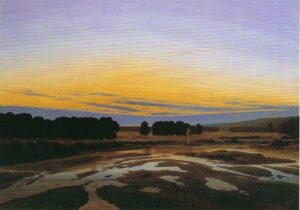
Caveat: if you walk through the whole of the Albertinum’s upper floor, brace yourself for the recent “art” at the end of the loop.
As a history buff and a fan of black-and-white line drawings, I love Dresden’s Fürstenzug, a.k.a. the Procession of Princes. It’s a frieze made of Meissen porcelain that shows 35 rulers of Saxony from the 12th to 19th centuries. It’s 335 feet long and about 30 feet high.
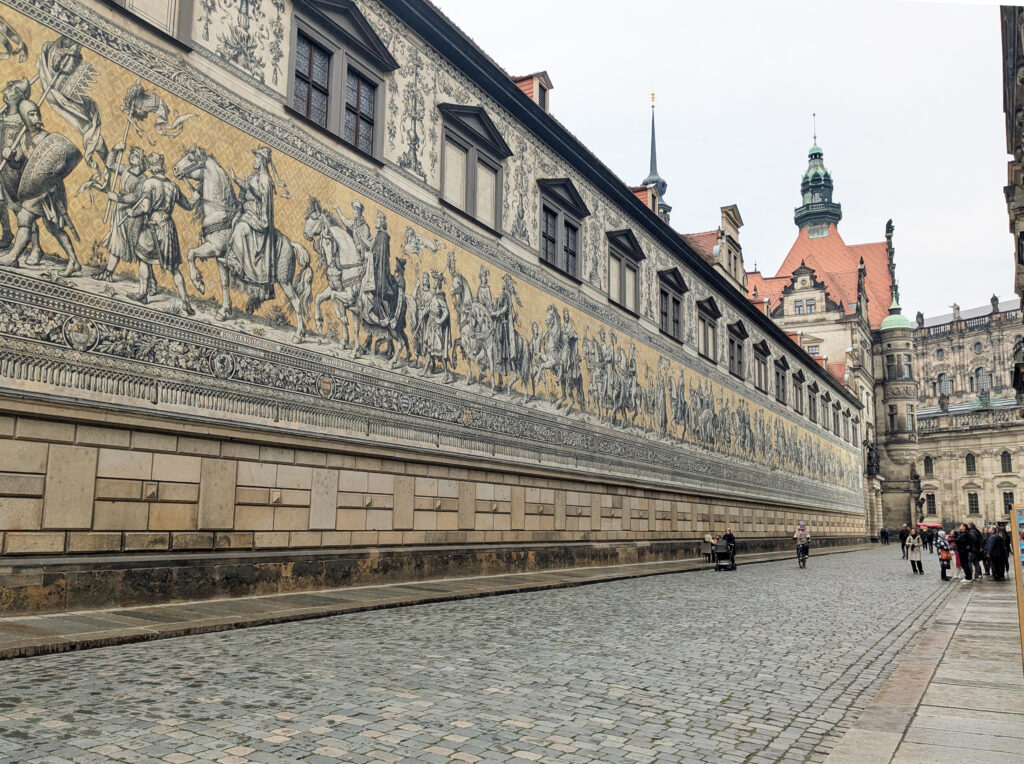
During World War 2, Dresden had the misfortune to be a rail hub and a center of production for Nazi war matériel. Near the end of the war, on February 13-14, 1945, the Allies launched a massive bombing raid against Dresden. Much of the city center was destroyed, including the Frauenkirche and the Semper Oper. An estimated 25,000 people died.
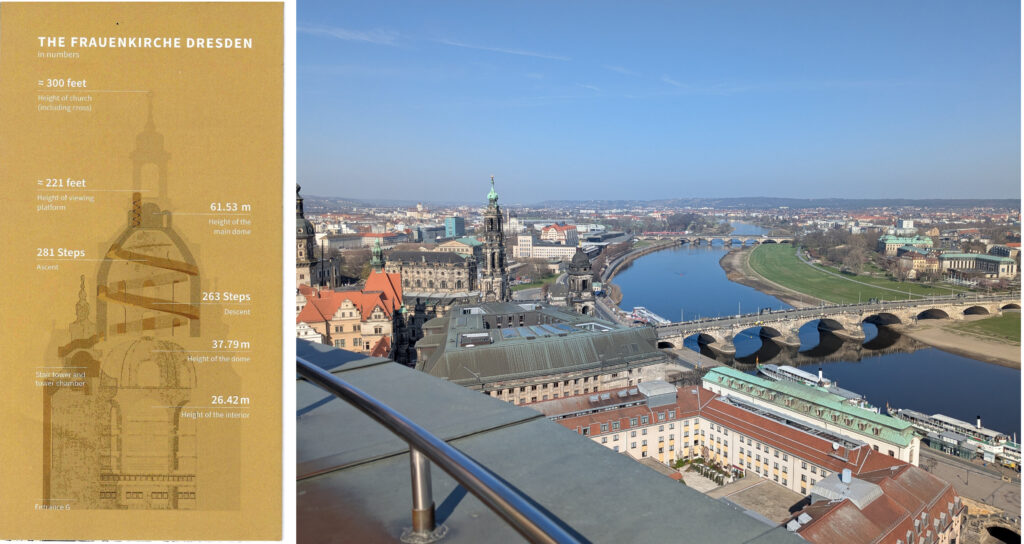
After the war, Dresden and Saxony became part of Communist East Germany. Dresden’s bombed-out city center was reconstructed beginning in the 1950s, mostly in the Baroque style. But the Frauenkirche was left a pile of rubble, ostensibly as a war memorial. After German reunification in 1991, the Frauenkirche was reconstructed stone by stone, beginning in 1994. It was reconsecrated in 2005. In the photo near the top of the post, the blocks that are black are original: the others had to be carved anew.
Notable if you like views: because the Frauenkirche was reconstructed so recently, the steps and ramps to the top of its tower (311 feet, 25 stories or so) are wide, have easily manageable inclines, and aren’t worn smooth with age. You can see into the dome as you climb and descend.
Music in Dresden
We saw Merry Wives of Windsor, a mid-19th c. operetta, at the Staatsoperette. The Staatsoperette is in a converted industrial building, but although the decor is rather spare, the acoustics are very good, and its seats are among the most comfortable I’ve ever experienced in an opera house. The Staatsoperette offers surtitles in German and English for songs, and a summary in English for the spoken dialogue.
At dusk one day we wandered through the plaza in front of the Frauenkirche and heard a soloist (taped back-up) playing an electronic cello: modern pop songs, including “Can’t Help Falling in Love with You”. I was told that it’s much, much better to tip in euros than dollars, because the exchange rate and fees mean a performer will end up with significantly less than you give him in dollars.
I had hoped to attend a concert of waltzes at the Zwinger, but it was sold out.
Do check out what musical offerings are available while you’re in town.
2. Culinary traditions
Dresden is on the Elbe River, home to fish such as trout, carp, pike, perch, bream, eel, and catfish. The surrounding area has good hunting for deer (Rehwild) and boar (Schwarzwild). Saxon cuisine leans toward hearty, slow-cooked comfort food that uses local, seasonal products, especially meat, potatoes, and beer.
2.1 Unusual ingredients
Cheese: Quark
Quark is a mild, fresh curd cheese with a high protein content, a creamy texture, and a slight tang (from lactic acid fermentation). In Dresden, it’s often used in cakes (Cheesecake,2.2.4). Common substitutes in cooking: thick Greek yogurt (although it’s not as dense as Quark) or a combination of 9 parts ricotta and 1 part sour cream.
Crayfish tails: Flusskrebs Schwänze
Tail of a shellfish from the Elbe River, often descried as a cross between shrimp and lobster. They are featured in Leipziger Allerlei (2.2.1). Native crayfish are now scarce: crayfish are now often imported from Louisiana.
Elderberries: Holunderbeeren
Small tart berries used in Holler Suppe (2.2.2). The elderberries I ate growing up in Pennsylvania were as much pit as berry.
Horse: Pferd
Very lean. May substitute for beef in pot roast (2.2.1, Sauerbraten) or in stews.
Lard: Schmalz
Rendered pork fat, sometimes with cracklings. Used as a spread (2.2.3).
Morel mushrooms: Morcheln
Nutty, earthy mushrooms with a honeycomb-like texture, foraged in the Spring. Used in Leipziger Allerlei (2.2.1), cream sauces for fish, stews, etc.
Pork, raw and minced: Mett
Uncooked ground pork seasoned with salt and pepper. Usually served open on rye bread, topped with onions, often with radishes on the side: as in Mettbrochen (2.2.3).
Venison: Reh
Lean and very gamey. Sometimes used in Pot roast(2.2.1).
2.2 Classic dishes
2.2.1 Entrees
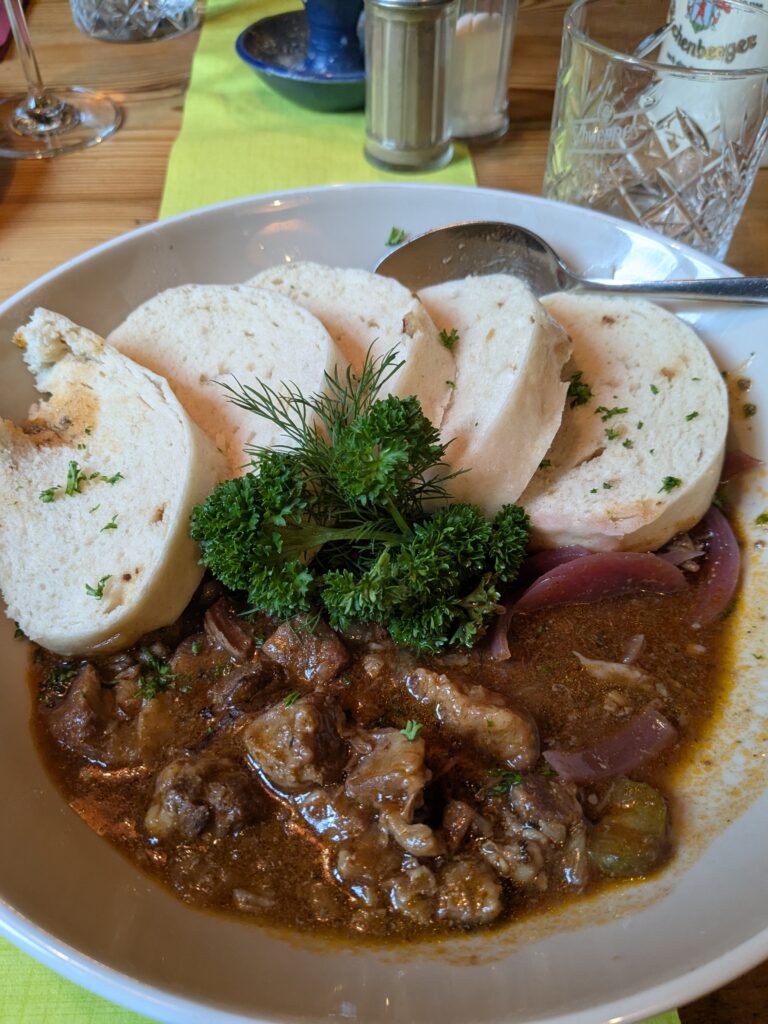
Goulash stew: Radeberger Biergulasch
Goulash stew, with beef, onions, paprika, and caraway, simmered in Radeberger Pilsner beer. Served with dumplings or bread.
Leipziger Allerlei
A vegetable medley of peas, carrots, asparagus, and morels (2.1), in a buttery sauce. If you’re not a vegetarian, get it with crayfish tails (2.1). NOTE: This is a seasonal dish, not available in mid-March.
Pot roast: Sauerbraten or Sächsische Sauerbraten
Pot roast of beef, or sometimes venison (2.1) or horse (2.1), marinated in vinegar, wine, herbs, and spices, then braised in sweet-sour gravy. Served with red cabbage (Rotkohl), potato dumplings (Klöße or Knödel), or bread dumplings (Semmelknödel).
Schnitzel or Jägerschnitzel
Breaded and fried cutlet topped with creamy mushroom sauce. Many West Germans prefer pork or veal cutlets, but some East Germans (including Dresdeners) prefer breaded hunting sausage (Jagdwurst). Served with potatoes, pasta, or Spätzle (egg noodles).
2.2.2 Soups
Elderberry soup: Holler Suppe
Elderberries (2.1) thickened into a broth, with lemon, spices (cinnamon, cloves), cream, and croutons or semolina dumplings (Grießklößchen). Served hot or cold.
Potato soup: Sachsische Kartoffelsuppe
Potato soup, a starter or light meal with a mix of potatoes, vegetables (onions, carrots, leeks), and browned sausages (often smoky local types) in a light vegetable broth. Variations: with prunes, steamed dumplings, or a dollop of sour cream.
2.2.3 Snacks
Most of these are available from street vendors.
Lard-topped rye bread: Fettbemme
Rye bread topped with Schmalz (2.1), then salt, and sometimes sliced onions or gherkins. No seasoning.
Pork on a bun: Mettbrötchen
Raw minced pork (2.1) on a bun, seasoned with salt and pepper, with onions and perhaps radishes for crunch.
Pork steak: Schwenkbraten
Grilled pork steak (usually neck, shoulder, or loin), thick and juicy, sometimes sliced. This is a favorite of summer BBQs. It’s cooked on a grill suspended over an open fire, which adds a smoky flavor. The marinade is key: common ingredients include onions, oil, garlic, juniper berries, paprika, pepper, mustard powder, cayenne, thyme, oregano, marjoram. Sometimes served on a roll, topped with caramelized or raw onions, mustard, herbs, etc. This is less common around Dresden than in western Germany.
Potato-cheese pancakes: Quarkkeulchen
Crispy fritters of grated potatoes, Quark cheese (2.1), flour, and eggs, lightly fried, then dusted with sugar and served with applesauce. Works as a sweet-savory side or snack.
Pretzels: Brezels
Freshly backed, either salted or filled with cheese and chives.
Sausages: Wurst
Thüringer Rostbratwurst is mild: grilled pork, beef and veal seasoned with salt, pepper, and marjoram. Sometimes served with sauerkraut.
2.2.4 Desserts
Cheesecake: Eierschecke
Yeast-dough base, creamy cheese filling (Quark, 2.1), and a custardy top (eggs, milk, butter, vanilla pudding). Variations: with apples, poppy seeds, raisins, chocolate. Often an afternoon snack: Kaffee und Kuchen (coffee and cake).
Dresdner Stollen or Christstollen
Like “Champagne” and “Camembert”, Dresdner Stollen is a protected appellation. By law, it’s a yeast bread with rum-soaked raisins, almonds, candied citrus peel (chewy!), and spices, dusted with powdered sugar. It’is popular at Christmas but available year-round, and can be eaten either as a dessert, or with butter for breakfast.
Emperor’s Mess: Kaiserschmarrn
Fluffy torn-up crepes, caramelized in butter, studded with raisins, dusted with powdered sugar and served with plum compote, applesauce, or berry jam. Supposedly created for Emperor Franz Joseph of Austria. I had this at a Biergarten: yummy!
2.2.5 Beverages
- Local beers include Watzke-Pils and Radeberger.
- Try a beer-lemonade combo (Radler) before biking.
2.3 For those with specific tastes or needs
2.3.1 For the meek
Spices are not used heavily in Dresden, and tend to be subtle. You can ask for ohne Gewürze (“without spices”). Mildest dishes:
- Entrees: Leipziger Allerlei (2.2.1), with or without crayfish. Fresh fish, simply prepared
- Soup: Potato soup (2.2.2)
- Snacks: lightly seasoned sausages (2.2.3, especially Thüringer Rostbratwurst. Lard-topped rye bread (2.2.3). Potato-cheese pancakes (2.2.3)
- Beverages: Radegerger Pilsner (unspiced lager). Apfelschorle (apple juice spritzer).
- Dessert: cheesecake (2.2.4).
2.3.2 For the bold
- Entrees: pot roast (2.2.1) with horse (2.1), venison (2.1), or boar, grilled or stewed with berries. Leipziger Allerlei with crayfish (2.2.1).
- Snacks: raw minced pork on bread (2.1). Lard-topped rye bread (2.2.3).
- Dessert: Dresdener Stollen (2.2.4).
2.3.3 Low-carb or diabetic
- Entrees: Elbe trout of carp, grilled or baked with lemon and herbs. Leipziger Allerlei (2.2.1). Pot roast (2.2.1): ask for no gravy, and red cabbage instead of dumplings.
- Soup: potato soup (2.2.2): ask for broth-based.
- Snacks: potato-cheese fritters (2.2.3) topped with unsweetened applesauce or herbs. Sausages 2.2.3).
- Beverages: water, unsweetened tea, light Saxon wines such as Elbe Riesling.
2.3.4 Low fat
Focus on lean proteins such as fish and broth-based soups. Avoid creams or fried items. Ask for “ohne Fett” (without fat).
- Entrees: fish (Elbe trout or carp), grilled with lemon and dill. Leipziger Allerlei (2.2.1), light on butter, no crayfish. Pot roast (2.2.1) with venison, braised without gravy, with fermented red cabbage.
- Soup: potato soup (2.2.2) with broth base, carrots, leeks, and onions; skip sausage and cream.
- Snacks / sides: sliced cucumber salad with vinegar, dill, and fat-free Quark cheese (2.1) or yogurt dressing (Gurkensalat). Jacket potatoes with Quark, chives, and vinegar or herbs.
- Beverages: herbal teas, Elbe Riesling.
2.3.5 Vegetarian
Some restaurants specialize in seasonal vegetarian options.
- Entrees: Leipziger Allerlei (2.2.1): skip the crayfish. Vegan versions of Schnitzel (2.2.1). Lentil meatloaf (Falscher Hase, “fake rabbit”).
- Soup: potato soup (2.2.2) without sausage.
- Snacks: potato-cheese fritters (2.2.3)
2.4 Restaurants
Michelin restaurants (all 1 star)
- Elements: Modern European. Small plates & sharing menus. Trendy.
- Genuss-Atelier: Modern German. Creative fusion of regional ingredients in tasting menus. Intimate and upscale.
- Heiderand: modern with international influences. In a grand historic house run by the Walther family.
Restaurants we visited
All these were very good – I’d happily go back to any and all of them. They all serve extremely generous portions, so my husband and I often shared a soup and then an entree.
- Anna, in the Residenzschloss
- Kunst Cafe Antik – near the Elbe, antique shop + restaurant. Hearty Saxon fare.
- Augustiner an der Frauenkirche – very crowded at 7:30 p.m. on a Sunday night; almost every table on both levels was occupied, but we could still hear each other talk. Although it’s right by the Frauenkirche (where most tourists end up), this restaurant seemed to be filled with Dresdeners.
- Gänsedieb – near the Altmarkt. Very good, and off the tourist track.
- Kreutzkamm pastry shop – 200 years old. Pastries from this shop are worth a carb-splurge.
- Dresdner Molkerei Gebrüder Pfund GmbH – fantastic ceramic tile interior. Guinness certifies it “the most beautiful cheese shop in the world.” Cheese and Dresdener Stollen.
- Planwirtschaft, in the “new” part of Dresden (Neustadt), a 45-min. walk across the Elbe from the Old Town (Altstadt). We went there for Leipziger Allerlei, but were told it’s not available in mid-March. This restaurant has the feel of a bar from the Communist era: very plain decor, and a couple comments on the 1st page of the menu about leaving reviews on “that capitalist tool, Google”.
- Near Pillnitz: Fährhaus Kleinzschachwitz, a Biergarten. Kaiserschmarrn (2.2.4)!
- Song Lam 37: Suchi and Thai food, very good if you want somehing light.
- Sfizio: pizza and standard Italian. The pizza had a decent sauce, great cheese & crust.
Other highly rated / recommended restaurants, per Grok
Italian restaurants are very common in Dresden, but I ignored them for this list, because I was scheduled to be in Venice in 2 weeks.
- Alte Meister Café & Restaurant: International, German. In the Zwinger Palace, with views. For Leipziger Allerlei.
- Caroussel Nouvelle: Modern European. Innovative seasonal menus. Historic building.
- Coselpalais: German. In a Baroque palace right by the Frauenkirche. Specializes in regional fare like duck and venison, with a focus on historic recipes.
- Kobalt Club Royal, in historic down center, with Saxon specialties. 4.9 stars.
- Sophienkeller: Saxon. Historic cellar restaurant, themed décor, live music. Watch cheesecake (2.2.4) being made.
Mentioned in Grok’s comments on Dresden food
- Pulverturn: medieval vault vibe, right by the Frauenkirche. Classic stews, including Sauerbraten (2.2.1) with horse meat.
- Kurfürstenschänke near Frauenkirche for goulash stew simmered in Radeberger Pilsner beer. Regional classics with customizable mildness.
More
- For other posts in the Fearless Foreign Foods series, see here.