You can also see this post on Substack.
Timeline 1700-1799 (The Integrated Timeline, book 1) is now available!
- Amazon print version (ASIN B0FMK72MFL) $40.00
- Ingram print version, via bookstores such as Barnes & Noble (ISBN 979-8-8691-8580-8) $40.00
- PDF (non-flowable ebook) via Gumroad: $15 here
- REVISED VERSION available as of 8/1/2026: see “Revised version” below.
Discover Timeline 1700-1799, a groundbreaking history book that transforms the past into a living guide for the present, and helps you shape the future. This meticulously researched work by Dianne L. Durante explores a century of major events, ideas, and trends. Read it decade by decade or follow specific categories such as politics worldwide, U.S. presidents, science, philosophy, literature, and music. Its 195 pages include cross-references that connect ideas and events across time, full-color illustrations of art and technology, excerpts from major fiction and nonfiction works, and a lengthy index.
This Timeline (the first in a series) is perfect for historians, art lovers, bookworms, and for anyone seeking context for today’s world. True, the 18th century is long ago, but it brought us the Industrial Revolution, Napoleon, the Declaration of Independence, and the Reign of Terror – not to mention Mozart’s Magic Flute, the Trevi Fountain, and Gulliver’s Travels.
The problem
Every day you must make choices about how to deal with the world you live in. Where will you live? How will you support yourself? What sort of food will you eat? Where will you invest your savings? What politicians will you support with your time and money?
Many of those choices will inevitably have long-term, life-altering consequences. If you don’t have a context for making such choices, you’re in danger—and you may not even see the danger coming. If you want to live happily in the present, you need to understand the past.
But also: if you want to change some aspect of the world, you need to know how we got where we are today. That means you need to understand the causes and effects, the ideas and consequences, that brought us to our present state. As Winston Churchill said, “The longer you can look back, the farther you can look forward.”
The solution
So how do you learn enough history to “look back”? Not by rote memorization of names and dates. That might help you win at trivia, but it won’t help you live your life. Narrative histories provide a broader perspective, but they’re so numerous and so voluminous that it’s tough to know where to start.
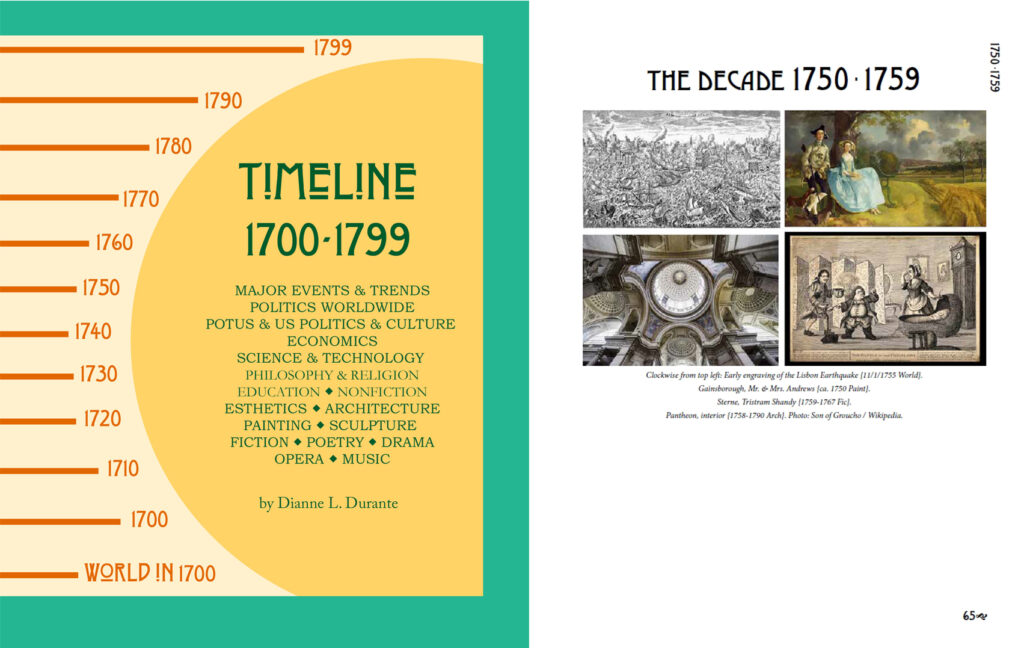
Timeline 1700-1799 aims to fill the gap between trivia and long-form history. It’s a concise summary of crucial people, works, and events, organized decade by decade. Each decade is broken down into categories: worldwide politics, US politics and culture, science and technology, philosophy and religion, esthetics, architecture, painting, sculpture, fiction, poetry, drama, opera, and music. To round out your image of the era, the Timeline includes illustrations of major artworks and technology, plus substantial excerpts from novels, speeches, pamphlets, letters, poetry, drama, and more.
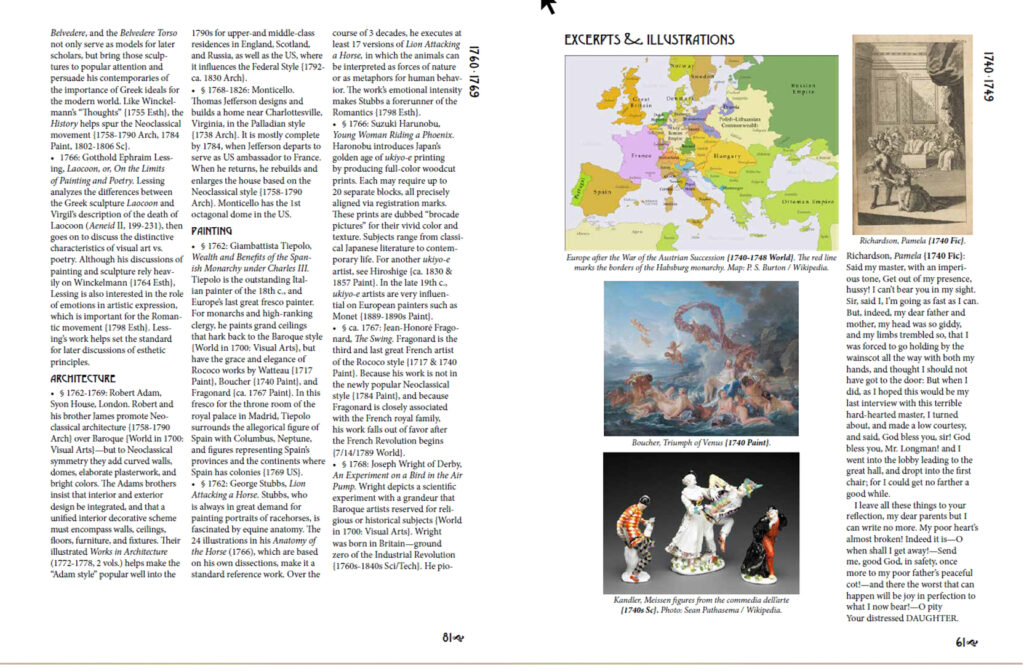
The Timeline is designed to be manageable. You can read it decade by decade. You can use it as a reference. You can check out a category that interests you. Whichever way you use it, the multitude of cross-references allows you to place what interests you in its historical and cultural context. These cross-references help you integrate your knowledge. And integration is your best defense against being fooled by an academic’s skewed interpretation of history, or an AI’s hallucinations.
To put it another way: the Timeline is meant as a scaffolding on which you can build a better understanding of the past and the present, and increase your ability to change the future—whatever you want that future to be.
Tooooo long ago?
Are you thinking you’ll wait for the timeline of the 20th or 21st century, because the 18th century is too distant to matter? Consider: that century brought us the Industrial Revolution, Napoleon, the Declaration of Independence, and the Reign of Terror. It also brought us Mozart’s Magic Flute, the Trevi Fountain, and Gulliver’s Travels. There’s a direct line from the Holy Roman Empire (est. 800 AD) to the rise of Prussia in the 18th century, and on to the rise of Nazism and Adolf Hitler in the 20th. To really understand the 19th, 20th, and 21st centuries, knowledge of the 18th century is essential.
Timeline 1800-1899 will appear next summer. The second edition of Timeline 1900-2021 will appear a year later.
Why I’m writing these timelines, and my creds
Five years ago, I was baffled when the world went bat-shit crazy over Covid-19, Trump, and Biden. My go-to means of coping in such situations is to look at the historical context for causes, connections, and correlations. It turned out there was no handy reference for doing that, so I wrote Timeline 1900-2021 (published 2022). Even as I finished that book, I realized I needed to go much further back to understand 21st-century ideas and events.
To judge whether you can trust a historian’s work, it’s useful to know his or her premises and methodology. Timeline 1700-1799 includes:
- The Introduction, setting out what I see as the purpose of studying history. An early version of the Introduction begins here (on Substack); YouTube video here.
- Appendix 1, discussing methodology: the sources I used and the choices I made regarding content and style. An early version starts here (on Substack); YouTube video here.
- Appendix 2 of the Timeline is my autobiography as a writer. It covers my education, experience, and operating principles. An early version starts here (on Substack).
No better time than the present to start
Buy Timeline 1700-1799 to start getting a grip on the past, so you can deal better with the present and plan for the future.
- Print version: 8.5 x 11”, 196 pp. on heavy white paper with full-color illustrations. Available for $40 via Amazon (ASIN B0FMK72MFL) or via Ingram (ISBN 979-8-8691-8580-8). NOTE: The print quality of the Amazon copies is better, but I’m offering it on Ingram for the sake of libraries and booksellers.
- Digital version: available if you want immediate gratification, access to the book wherever you happen to be, and a lower price ($15). The digital version is a non-flowable PDF. On a computer monitor, you’ll see the pages exactly as they are in the print version. NOTE: If you buy the PDF from Gumroad and read it in Kindle, the text will be extracted in a very, very messy way. I can’t stop you from trying, but I don’t recommend it.
Timeline & supplementary posts on Substack
Free followers on Substack have access to the monthly Music playlists and Connections posts for every decade since 1700. Several other free posts appear each month, such as a series on education in the US (3 posts, starting here), the Russo-Ukrainian War (6 posts, starting here), and US immigration and citizenship (18 posts, table of contents here).
Paid supporters on Substack receive the monthly decade-by-decade posts. These are laid out as for the finished Timeline. In progress: 1800-1899, which will run from August 2025 to July 2026.
Whether you’re a free or paid supporter, you’ll know as soon as the next book in the Timeline series is published.
Revised version of Timeline 1700-1799
A revised version of Timeline 1700-1799 is now available on Amazon and Ingram ($40) and via Gumroad ($15). It includes several new entries, most notably one on Babeuf. This guy is mentioned in the Communist Manifesto {2/21/1848 Econ} as one of Marx’s heroes. I didn’t know such ideas could be traced so far back!
1797 (May 27): François-Noël (Gracchus) Babeuf is executed. Babeuf, a journalist, advocated radical egalitarianism: redistribution of land and income. In the 1790s, he is imprisoned several times for his political writings, which are too radical even for French revolutionaries. In 1796, he heads the “Conspiracy of Equals” that plans to overthrow the French Constitution of 1795 {10/26/1795 World}. For this he is guillotined. Babeuf’s techniques become a model for 19th- and 20th-c. revolutionaries: a small clandestine group conspires to overthrow the government by infiltration and subversion; it uses propaganda (newspapers, posters, songs) to rouse the masses; and it institutes a transitional dictatorship to impose the new political system. Babeuf is regarded as a martyr and a hero by 19th-c. revolutionaries such as Marx and Engels {2/21/1848 Econ}, who regard Babeuf as the 1st advocate of communism, and by Blanqui {1867-1868 Econ}.
More
- Subscribe on Substack (free or paid) to follow the Timeline series.