The Power and Pathos exhibition of Hellenistic bronzes has moved from the Getty Museum to the National Gallery in Washington – its final stop. If you have the chance, do see it. Even more than paintings, sculptures need to be seen in person. You can enjoy the works in the exhibition just as art, but if you want to know the context, read the relevant chapters in my Innovators in Sculpture. Several of the works in the show are used as illustrations in the book.
I went through the exhibition twice, with a couple-hour break in between. (Cleansed my palate with some Baroque paintings and 19th-century sculpture.) I know a fair amount about the art of this period, so I skipped most of the labels and the audio tour. My husband, who did listen to the audio, enjoyed it very much. The exhibition catalogue is the usual massive academic effort: I read the bits that interested me from one of the copies left for public perusal within the galleries. If it were cheap, I’d buy it and cut out pics for my wall; but it ain’t cheap.
I would like to take this opportunity to complain bitterly that visitors are not allowed to take photos in the exhibition. The ones below are mostly from the National Gallery’s pages on the Power and Pathos exhibition.
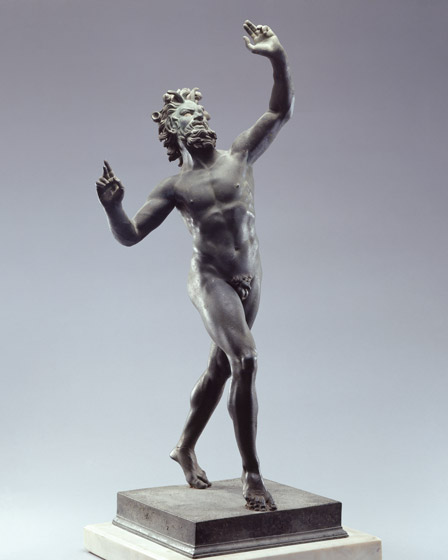
Dancing Faun
An unexpected favorite: beautiful pose, anatomy, and sense of glee, all in a piece barely 2 feet high. The photo does not do it justice. Details here.
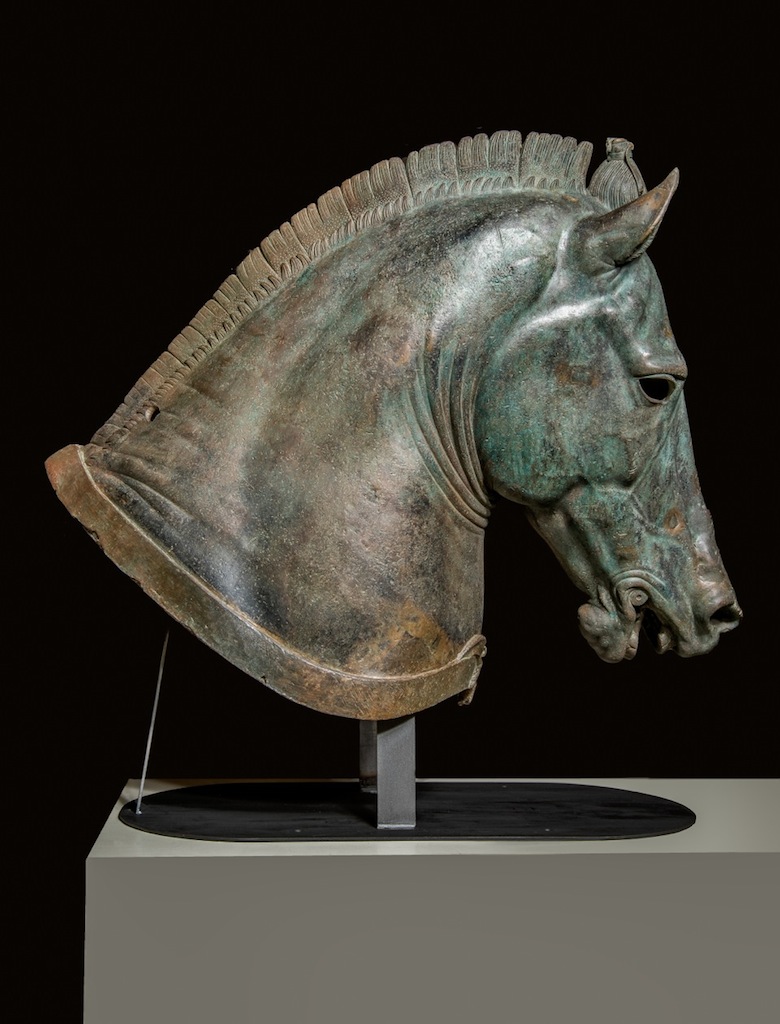
Head of a horse
Now that enormous head of Constantine isn’t the only piece in my file for “colossal ancient sculpture.” Most of the colossal bronzes of the ancient world have been lost: this fragment, with its remarkable stylization and traces of gilt, makes me regret the loss even more than I used to.
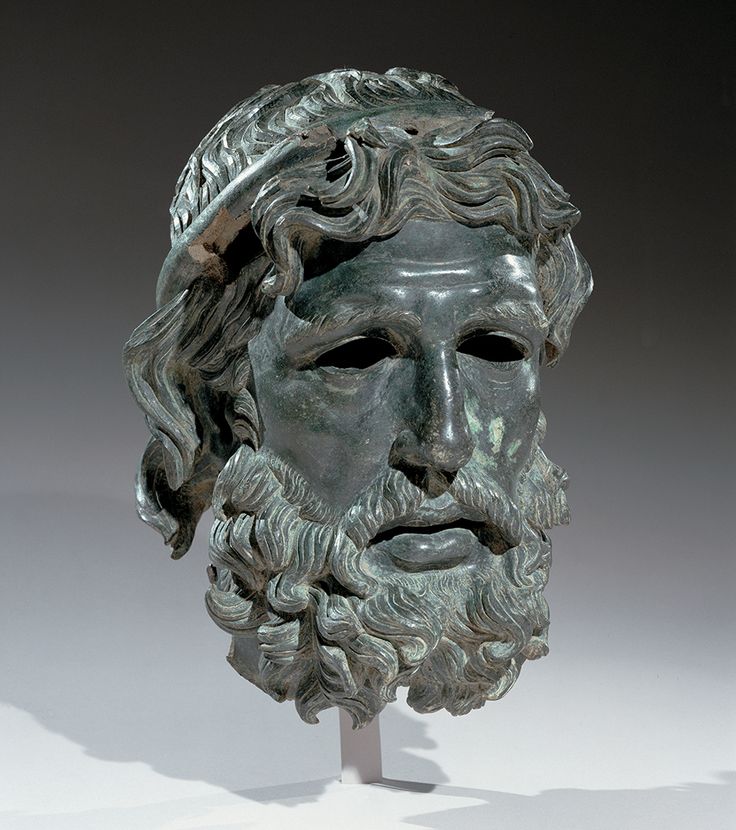
Head of a God?
Age should be like this: wiser, stronger. Get to the right image on the Getty’s page via this Pinterest link. The National Gallery used this for the T-shirts of the exhibition.
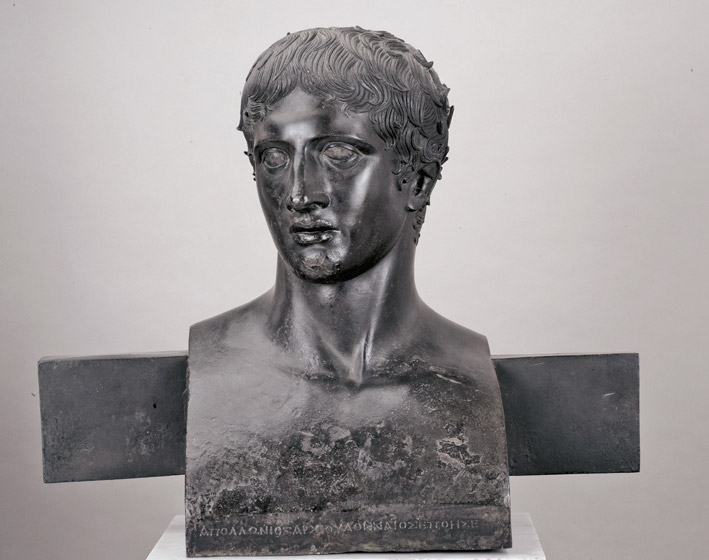
Head of the Doryphoros
This one’s not bronze, but a very dense, dark stone that looks much like bronze with a dark patina. I love the sculptures of the Early Classical period, when Polycleitus was at work: so much excitement at learning, and so much dignity and calm. (This makes two favorites on this list that live at Naples. I need to spend more time in Naples!) More here.
Idolino
OK, it’s not “real” – it’s a combination of a Polycleitan head (mid-5th c. BC) and a Lysippean body (mid-4th c. BC). (See Innovators in Sculpture.) That doesn’t mean I can’t like the shape, the pose, the mood, and that crazy pedestal that an artist of the Italian Renaissance designed for it. More here.
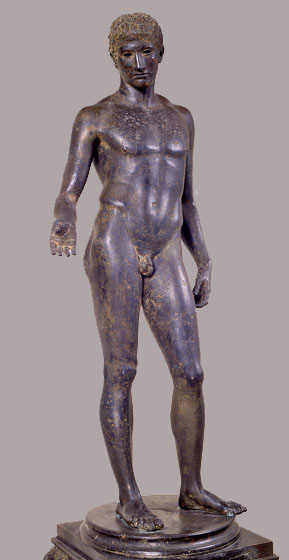
Boy from Heraklion
I kept trying (am still trying) to decide what he’s thinking … It changes as I move around the sculpture. Found 1958. Details here.

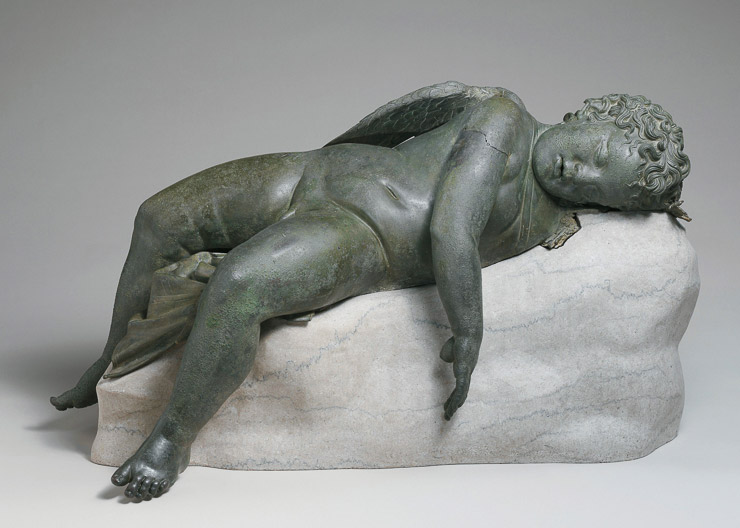
Sleeping Eros
This one almost didn’t make it to this post, because he’s one of “my” sculptures (i.e., he lives at the Metropolitan Museum of Art). But he’s so utterly charming, and such a wonderful illustration of the fact that by this period – say 2nd c. BC – artists were really looking at everyone, rather than representing an idealized form. The limpness, the proportions, the musculature are so right for a toddler. Details here.
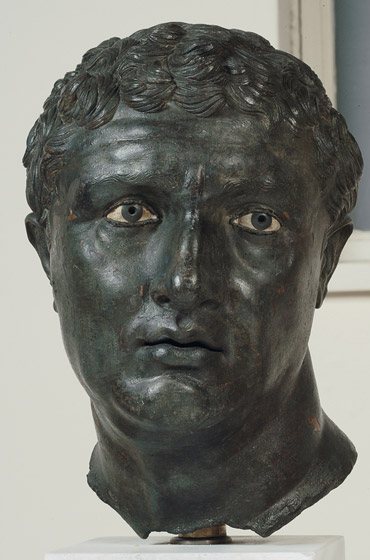
The Delos Head
This guy is my image of the Mind of Hellenistic Man: highly intelligent and cultured, but way off the track philosophically. See Innovators in Sculpture. If you look at his left profile (proper left, that is), the lines of worry between his brows disappear, and the mood is completely different.
Would be here if I could find a decent photo
Portrait of a ruler (Demetrios Poliorketes?), 310-290 BC, in the Prado. The right profile is lovely. The other eye is distorted, which makes the whole face seem “off” in a full-frontal photo. Photo and details here (scroll about halfway down), and on the Prado’s site.
Best part of the exhibition
All the pieces I hadn’t seen, many of which have been dredged up from the sea in the past 20-30 years. It makes me so happy to think that more works such as the Riace Warriors (found in 1972) may be discovered!
Biggest disappointments
Even though a photo isn’t as good as seeing the real sculpture in 3D, I would have liked to have photos of the works above. But only three works out of all those in the exhibition are available as postcards. I don’t recall any in larger prints for sale. The Sleeping Eros is for sale as a rather crappy bronze model. The Zeus of Artemisium (who’s not Hellenistic) is for sale in an extraordinarily crappy model.
Also: I had a list of favorites at the National Gallery that I wanted to visit – some of them posted earlier on this blog. Rather than carry a print-out, I decided to use the National Gallery’s option to flag them as favorites, which (after you create an account and sign in) saves the “object page” of the artwork, which in turn links to a map of which gallery the artwork lives in. I hoped that when I arrived, I’d be able to pull up a map that showed the location of all those works at once. Alas, I couldn’t even reach the list of favorites when I was on the mobile site. I still can’t. On the desktop site, if you’re signed in, clicking the star near the search bar will get you there. On my phone, I can’t find a star or a sign-in box.
More
- In Getting More Enjoyment from Sculpture You Love, I demonstrate a method for looking at sculptures in detail, in depth, and on your own. Learn to enjoy your favorite sculptures more, and find new favorites. Available on Amazon in print and Kindle formats. More here.
- Want wonderful art delivered weekly to your inbox? Check out my free Sunday Recommendations list and rewards for recurring support: details here.