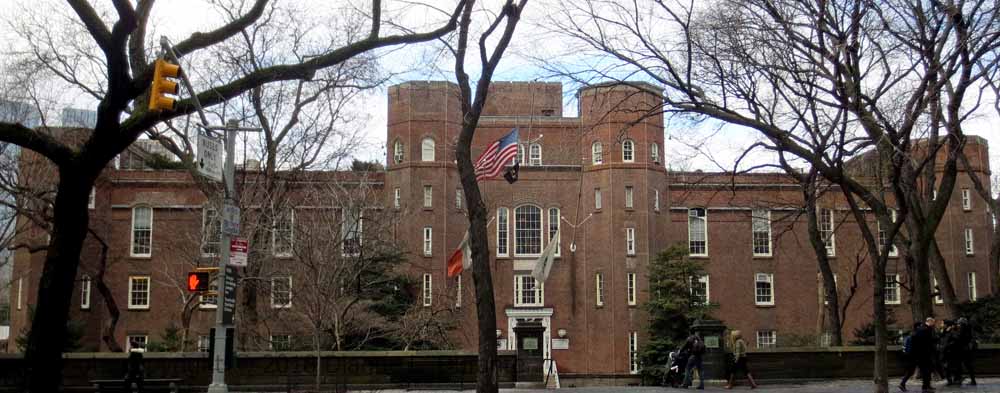
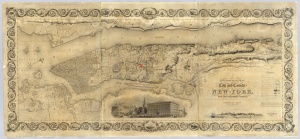
The Arsenal has a motley past. Despite its forbidding battlements, it wasn’t designed to withstand a siege – only to store gunpowder and cannonballs so that they could be hauled quickly to any part of Manhattan that came under attack. The present building was constructed in 1851 very near the site marked “Powder House” on this 1836 map. (Zoom in on the map on David Rumsey’s site.) I haven’t been able to find any images of the Arsenal when it was first constructed.
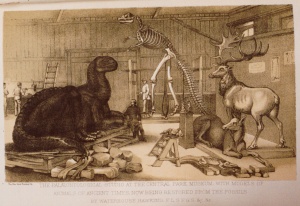
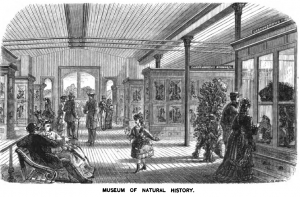
In 1853, two years after the Arsenal was completed, the New York State Legislature authorized the purchase of the land around it for Central Park. As one of the few buildings on the park site that wasn’t razed, the Arsenal became the headquarters for the Board of Commissioners and the Park’s police force. They shared it with eclectic displays of sculpture and scientific oddities. In the basement, live animals from the menagerie contributed a lingering stench.
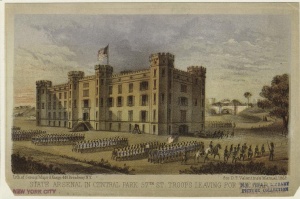
The Arsenal reverted to a military function for a few years, housing Union soldiers on their way to the front lines of the Civil War. This 1862 print of troops drilling in front of the Arsenal is the earliest dated image I’ve found of the building. This is the Arsenal’s east side, facing Fifth Avenue, which has a double set of stairs leading to a doorway. Central Park is visible in the background: today that view is blocked by the zoo.
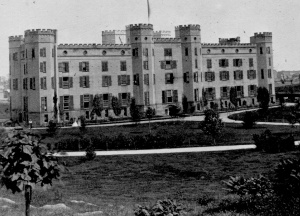
This is the west facade, facing the section of the Park that now holds the zoo.
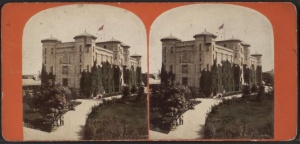
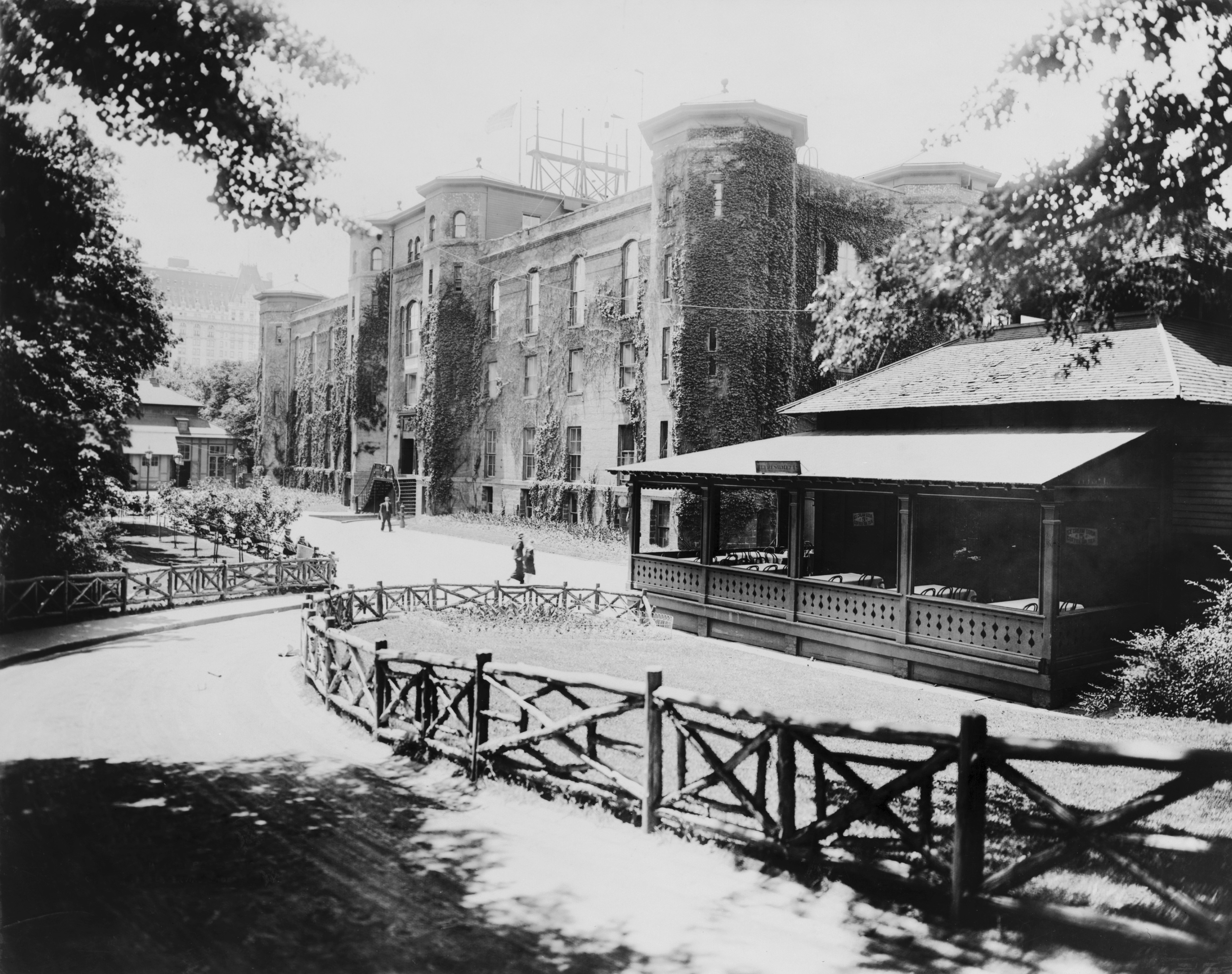
Sometime in the late 19th century, the battlements were torn off and colorful cupolas were stuck on top of the turrets.
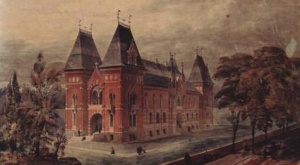
In 1865, famed architect Richard Morris Hunt drew up a plan for upgrading the Arsenal into a magnificent museum. Like, wow. That didn’t work out.
The artwork from the Arsenal was soon moved to the former convent of Mount St. Vincent, at the north end of the Park. (Search “Vincent” on this page.)
In 1877, the American Museum of Natural History took the dinosaur bones and other scientific material to custom-built quarters on Central Park West.
Soon after the five boroughs were consolidated in 1898, the Board of Commissioners of Central Park moved downtown to the new Municipal Building at Chambers and Centre. At the Arsenal, with its broken windows and holes in the roof, only the weather service was left.
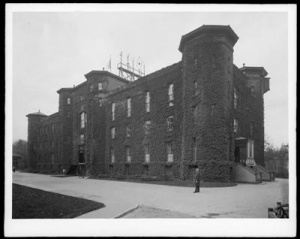
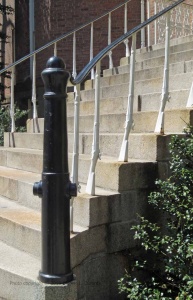
During the Great Depression, along came Robert Moses with millions of dollars in federal relief and an army of unemployed. He ordered the Arsenal’s exterior to be sandblasted back to the original brick. The kitschy cupolas were torn off, the oh-so-inauthentic battlements were replaced. The entrance was decorated with military details. The Arsenal became the command center for Robert Moses’ Parks Commission. Today the Arsenal houses the offices of the Central Park Conservancy, the Parks Department, and a gallery.
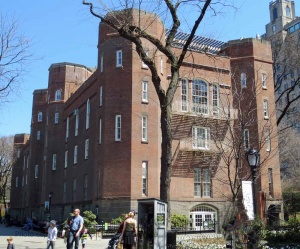
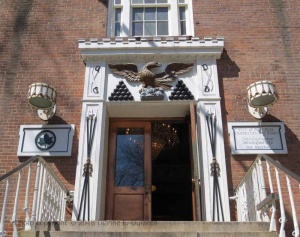
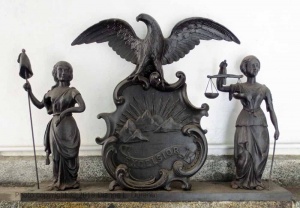
Beneath the stairs leading to the Arsenal’s main entrance is this small (three feet wide?) group, without a label. The style looks like something that might have been produced in the mid-19th century. I’m guessing it was over the doorway before Moses remodeled the building.
I think I can just see it over the entrance in this image from 1914. What do you think? Larger image here.
More
- On the history of the Arsenal, see also the NYC Parks Department’s website.
- For more on Central Park in the nineteenth century, see my book Central Park: The Early Years (details here) and my webpage incorporating an ever-increasing number of old images of the Park. Click on the “Central Park” tag in the Obsessions cloud at lower right for more posts on the Park.
- Want wonderful art delivered weekly to your inbox? Check out my free Sunday Recommendations list and recurring support: details here.